Arsenic in rice: how to cook it to cut it down
Parboiling rice and pouring off the water removed up to 73% of its inorganic arsenic. What your AS3MT gene does with the rest and what your genotype suggests.
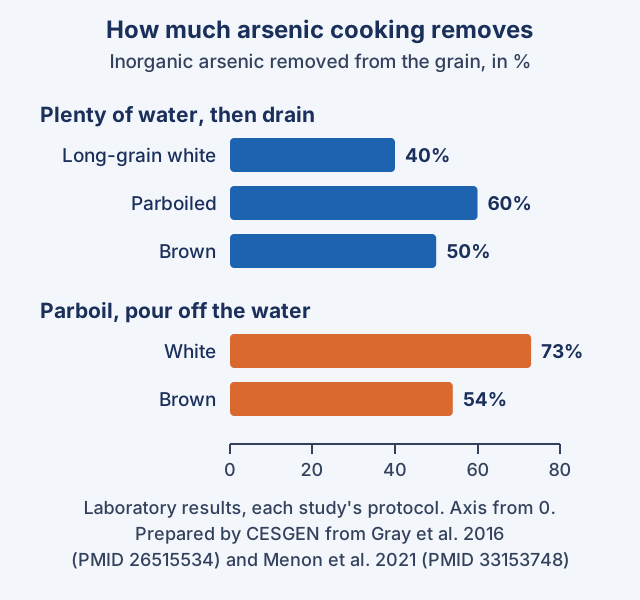
Rice is, together with other cereals and drinking water, one of the main sources of inorganic arsenic in the European diet (EFSA, 2024), and the way you cook it makes a big difference to how much reaches your plate. Cooking it in plenty of water and draining it, like pasta, reduced inorganic arsenic by between 40% and 60% depending on the type of rice (Gray and colleagues, 2016), and parboiling it in plenty of water, pouring that water away and finishing it in just enough fresh water reduced it, with that study's protocol, by 73% in white rice and 54% in brown rice (Menon and colleagues, 2021). What remains is processed by the liver with the help of an enzyme, AS3MT, which adds methyl groups to arsenic so that it is more easily removed in urine. Nutrigenomics adds two things here: a variant near the AS3MT gene, rs9527, which was associated in Bangladesh with less efficient methylation (Pierce and colleagues, 2012), and the role of folate, which supplies the methyl groups for that reaction (Gamble and colleagues, 2006). The practical message is concrete: cooking rice in a way that removes some of the arsenic and varying your cereals applies to everyone; and your rs9527 genotype suggests how much to focus on it: with the variant, as something to try and observe, it makes sense to reduce exposure further and look after the folate that supplies the methyl groups.
Where dietary arsenic comes from
EFSA updated its assessment in 2024: epidemiological studies associate chronic intake of inorganic arsenic, through diet or water, with a higher risk of several health problems, including cancers of the skin, bladder and lung. With the dietary exposure of European adults, the margin from the reference dose is low and, despite the uncertainties, EFSA concludes that it raises a health concern. The foods that contribute most, at all ages, are rice, rice-based products, other cereals and cereal products, and drinking water (EFSA, 2024).
For babies and young children, some specific foods also contribute, and food safety authorities give their own advice for those ages, which is the advice to follow.
How to cook rice to cut the arsenic
The inorganic arsenic in rice is mainly on the surface of the grain and dissolves in water, which is why cooking makes such a difference (Menon and colleagues, 2021). Two methods that can be done at home have been studied.
Cook in plenty of water and drain. This is how pasta is cooked. In a study by the US Food and Drug Administration, it reduced inorganic arsenic on average by 40% in long-grain white rice, 60% in parboiled rice and 50% in brown rice. Rinsing the rice before cooking, by contrast, barely changed the arsenic (Gray and colleagues, 2016).
Parboil and pour off the water. This means parboiling the rice in plenty of water, pouring that water away and finishing the cooking with just enough fresh water for the rice to absorb it. In a study from the University of Sheffield, it was the best of the methods tested: with the study's protocol, it removed 73% of the inorganic arsenic from white rice and 54% from brown rice, and it kept more nutrients than traditional cooking in excess water (Menon and colleagues, 2021). These are reductions measured in the laboratory with that protocol; at home, the result will depend on the timings and the amount of water.
White or brown? In a sample of rice sold in the UK, brown rice had more inorganic arsenic than white (Menon and colleagues, 2020), but also considerably more minerals, and in its analysis of 55 types of rice the same group concluded that the amount of rice matters more for risk than the type (Menon and colleagues, 2022). Varying your cereals over the week reduces exposure without giving up rice.
One letter, one change: the AS3MT region
In the liver, the AS3MT enzyme transfers methyl groups from S-adenosylmethionine to arsenic and converts it, in two steps, into monomethylarsonic acid (MMA) and dimethylarsinic acid (DMA) (EFSA, 2024). DMA is more easily removed in urine, and the authors of the main study in this post consider it the less toxic of the two forms (Pierce and colleagues, 2012).
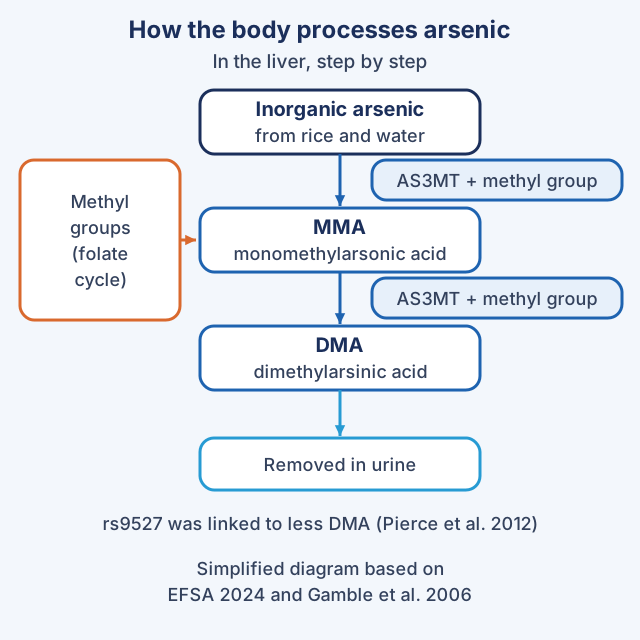
The variant rs9527 lies in the region of chromosome 10 that contains AS3MT, in a neighbouring gene now called BORCS7 (formerly C10orf32), and it was associated with the amount of AS3MT expressed by lymphocytes (Pierce and colleagues, 2012). On the forward strand of the genome, the one used by dbSNP and most files, the common allele is C and the variant is T; the Pierce study writes it on the other strand, as G and A. According to the 1000 Genomes Project, the T allele is found in 26.6% of chromosomes in the Spanish population and 7% in the Bangladeshi population.
What was seen in Bangladesh
The first genome-wide study of arsenic metabolism was carried out in 1,313 adults from Araihazar, in Bangladesh, who drank water from wells containing arsenic. Five variants in the AS3MT region were independently associated with the proportions of arsenic metabolites in urine. The variant allele of rs9527 was associated with less DMA, that is, with less complete methylation of arsenic. In 1,085 people with arsenic-related skin lesions and 1,794 without, that allele was associated with 42% higher odds of lesions (OR 1.42; 95% confidence interval, 1.16 to 1.72), in a model that estimates the effect of the allele rather than that of each genotype separately, and its effect depended on the arsenic in the water they were exposed to (Pierce and colleagues, 2012). The authors declare no competing interests.
Folate, methyl groups and arsenic
The methyl groups used by AS3MT come from the folate cycle, the same cycle in which the MTHFR enzyme works, which we covered in the posts on vitamin B2 and on the queen bee. In a randomised trial with 200 adults in Bangladesh with low plasma folate and exposure to arsenic in their water, those who took folic acid for 12 weeks went from excreting 72% of urinary arsenic as DMA to 79%, a significantly greater increase than with placebo (Gamble and colleagues, 2006). This is a result in people with low folate and high exposure; for everyone else, the practical conclusion is to meet your folate needs from food.
Genotype and diet: what the evidence says
The table summarises results from groups of people and does not necessarily predict your own case. Genotypes are named with the forward-strand letters, the ones in your file, and in brackets with the letters used in the study.
| Your rs9527 genotype | What has been observed | What you can do |
|---|---|---|
| CC (GG in the study) | The most common genotype. It does not carry the variant that was associated with less DMA, that is, with less complete methylation of arsenic, and with more skin lesions in Bangladesh (Pierce and colleagues, 2012). | Your arsenic methylation does not carry that variant: cook rice in plenty of water and drain it, and you can choose brown rice for its minerals, cooked the same way. Vary your cereals over the week and meet your folate needs from food (330 µg of dietary folate equivalents a day for adults; EFSA, 2014). |
| CT (GA) | One copy of the allele that, in Bangladesh and with heavily contaminated well water, was associated with less DMA in urine and more skin lesions (Pierce and colleagues, 2012). | With one copy, your body may methylate arsenic slightly less completely. As something to try and observe: make parboiling and pouring off the water, the method that removes the most arsenic, your usual way of preparing rice; swap one or two servings of rice a week for other cereals; and make sure you have a source of folate every day (pulses or green leafy vegetables), because it supplies the methyl groups AS3MT uses. |
| TT (AA) | Two copies of that allele. The study estimated the effect of the allele, which you carry twice (Pierce and colleagues, 2012). | With two copies, reducing exposure and supporting methylation makes the most sense. As something to try and observe: the same as for CT and, in addition, if you eat rice often, choose white or parboiled rice for everyday meals and keep brown rice for occasional use, always parboiled with the water poured off; do not make rice drinks or rice cakes a daily staple; and ask your health professional to assess your folate status, for example with homocysteine, at your next blood test. |
On the levels of evidence: that rice is one of the main sources of inorganic arsenic and that it is worth reducing exposure is an EFSA conclusion for the whole population, and it is the base of all three rows. That cooking rice in plenty of water, or parboiling it and pouring off the water, reduces its arsenic has been measured in the laboratory in two independent studies with different types of rice, and that brown rice contains more inorganic arsenic than white has been measured in rice sold in the UK (Menon and colleagues, 2020). The association of rs9527 with methylation and with skin lesions comes from a single study in a population in Bangladesh with high exposure through water (‘Exploratory, not actionable’), and it has not been measured at the usual dietary exposure in Europe. That is why what is added for CT and TT is framed as something to try and observe: these are actions that follow the mechanism, less arsenic on the plate and more methyl groups to remove it, that do no harm and that are graded by the number of copies. The amount of rice swapped for other cereals is a CESGEN suggestion, not a limit derived from a study.
If you have a genetic file
If your file is from 23andMe or AncestryDNA, look for rs9527 (the steps are in the genetic file guide). This post uses the letters of the forward strand of the reference genome, the one used by dbSNP: C and T. The Bangladesh study used those of the other strand, G and A. Check the header or documentation of your file to see which strand it uses before applying the table.
| What you will see in your file | What this post calls it | What has been observed |
|---|---|---|
| rs9527: CC | CC genotype (GG in the study) | Without the variant associated with less arsenic methylation |
| rs9527: CT or TC | CT genotype (GA in the study) | One copy of the variant associated with less DMA and more skin lesions in Bangladesh |
| rs9527: TT | TT genotype (AA in the study) | Two copies of that variant |
| Any other combination (for example, G or A in a forward-strand file), or dashes or zeros | Cannot be determined from this file | Check the strand and format before interpreting |
Your file's chip may not include this variant. This table describes what has been observed in studies and does not replace an assessment by a health professional.
What to bear in mind when applying it
The genetic study was done with high exposure. The participants in Bangladesh drank water from wells containing arsenic, an exposure far higher than that from diet in Europe. The study shows that the variant influences how arsenic is metabolised; how much it matters with the usual diet in Europe has not been measured.
Cooking reduces arsenic, but also some nutrients. Cooking in plenty of water washes out some of the iron, folate, thiamin and niacin added to enriched rice, a common product in the United States; in brown rice, which is not enriched, the loss was much smaller (Gray and colleagues, 2016). Parboiling with a change of water kept more nutrients than traditional cooking in excess water (Menon and colleagues, 2021).
Young children have their own advice. For babies and young children, follow the recommendations of food safety authorities on rice, infant cereals and rice drinks.
This post does not recommend supplements based on a variant. The trial by Gamble and colleagues gave folic acid to people with low folate and high arsenic exposure. Whatever your genotype, the advice is to meet your folate needs from food, and the decision about a supplement is for your health professional.
What you can do with this information
Change the way you cook rice. Parboil it in plenty of water, pour that water away and finish it in just enough fresh water; or cook it like pasta and drain it. Rinsing it beforehand, on its own, barely changes the arsenic.
Vary your cereals. Alternate rice with pasta, couscous, oats, quinoa or potatoes over the week: the amount of rice is what matters most.
Meet your folate needs from food. Pulses and green leafy vegetables help you reach the reference intake of 330 µg a day, and give your body the methyl groups it also uses to remove arsenic.
Adjust to your genotype. With CC, cooking in plenty of water and varying your cereals is enough, and brown rice is a good choice. With CT, as something to try and observe, make parboiling and pouring off the water your usual method, swap one or two servings of rice a week for other cereals and make sure of your folate every day. With TT, in addition, choose white or parboiled rice for everyday meals, do not make rice drinks or rice cakes a daily staple and discuss your folate status with your health professional.
Rice does not have to leave your kitchen: cooked differently and alternated with other cereals, it is just another part of a varied diet. Your genotype does not decide for you, but it tells you where your effort is most worthwhile.
Sources
- Update of the risk assessment of inorganic arsenic in food, EFSA Panel on Contaminants in the Food Chain (CONTAM). EFSA Journal 22(1):e8488 (PMID 38239496), 2024
- Cooking rice in excess water reduces both arsenic and enriched vitamins in the cooked grain, Gray PJ et al. Food Additives & Contaminants: Part A 33:78-85 (PMID 26515534), 2016
- Improved rice cooking approach to maximise arsenic removal while preserving nutrient elements, Menon M et al. Science of the Total Environment 755:143341 (PMID 33153748), 2021
- Do arsenic levels in rice pose a health risk to the UK population?, Menon M et al. Ecotoxicology and Environmental Safety 197:110601 (PMID 32302858), 2020
- Essential nutrient element profiles in rice types: a risk-benefit assessment including inorganic arsenic, Menon M et al. British Journal of Nutrition 128:888-899 (PMID 34776015), 2022
- Genome-wide association study identifies chromosome 10q24.32 variants associated with arsenic metabolism and toxicity phenotypes in Bangladesh, Pierce BL et al. PLoS Genetics 8:e1002522 (PMID 22383894), 2012
- Folate and arsenic metabolism: a double-blind, placebo-controlled folic acid-supplementation trial in Bangladesh, Gamble MV et al. American Journal of Clinical Nutrition 84:1093-1101 (PMID 17093162), 2006
- Scientific Opinion on Dietary Reference Values for folate, EFSA Panel on Dietetic Products, Nutrition and Allergies (NDA). EFSA Journal 12(11):3893, 2014
- dbSNP and Ensembl, rs9527: forward-strand alleles, nearby genes and 1000 Genomes Project frequencies (GRCh38), NCBI dbSNP and Ensembl (1000 Genomes phase 3 frequencies: IBS, BEB and EUR), accessed 20/11/2026, 2026
Educational content from CESGEN, based on the evidence published up to the review date. It does not replace individual medical or dietary advice: to apply it to your own case, talk it through with your health professional. Nutrigenetics is an evolving field, and we review each piece when the evidence changes.