Queen bee or worker? It comes down to food
One honeybee larva becomes a queen or a worker depending on its food, and the queen lives 10 to 20 times longer. What epigenetics teaches and where MTHFR fits.
The same honeybee larva can become a queen or a worker, and the difference is huge: the queen lays the eggs for the whole hive and lives 10 to 20 times longer than the workers (Maleszka, 2018). What decides each larva's fate is food: from the third day onwards, only future queens keep receiving royal jelly in abundance, while workers switch to a diet of pollen and sugars (Maleszka, 2018). It is one of the clearest examples of what epigenetics studies: how the environment, and diet in particular, changes which genes are used without changing the DNA sequence. People do not have castes, but nutrigenomics finds a similar idea, which we use here as an analogy: in people with the TT genotype of the MTHFR gene, DNA methylation was lower when blood folate was also low (Friso and colleagues, 2002). The practical message is concrete: meet your folate and vitamin B2 needs from food and, if your genotype is TT, make B2 a daily priority.
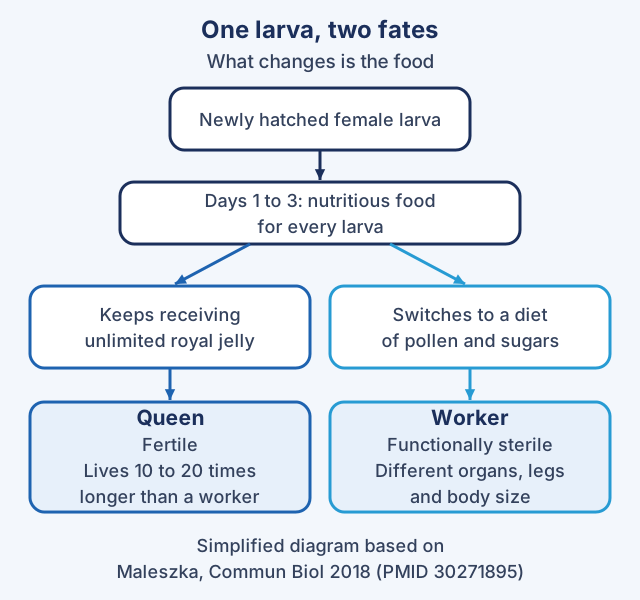
One larva, two fates
A newly hatched female larva can develop into a queen or a worker, and what decides the path is how it is fed: in experiments, genetically identical larvae follow one path or the other depending on the food they receive (Kucharski and colleagues, 2008). For the first three days, worker larvae also receive a nutritious food, which seems to contain less sugar than the queens' food. After that, future workers switch to pollen and sugars, while future queens keep receiving unlimited royal jelly, a secretion from the head glands of nurse bees (Maleszka, 2018). The result is two very different animals: the queen, fertile and far longer-lived; the worker, functionally sterile, with different sense organs, different hind legs and a different body size (Maleszka, 2018).
What the 2008 experiment showed
In 2008, a group at the Australian National University silenced, in newly hatched larvae, the gene for an enzyme called DNA methyltransferase 3 (Dnmt3), which adds chemical tags (methyl groups) to DNA. Most of those larvae became queens with fully developed ovaries, an effect similar to that of royal jelly (Kucharski and colleagues, 2008). Two years later, a study in which the same group took part compared brain DNA from queens and workers and found more than 550 genes with a different methylation pattern between the two castes (Lyko and colleagues, 2010).
The conclusion drawn at the time was very appealing: food changes methylation, and methylation decides whether a larva becomes a queen or a worker.
How science corrects itself: the royalactin story
In 2011, a Japanese researcher proposed that a single royal jelly protein, which he named royalactin, was enough to turn a larva into a queen (Kamakura, 2011). In 2016, another team tried to repeat some of those experiments without success and concluded that royalactin was not the key to the queen (Buttstedt and colleagues, 2016). The original author replied that the new experiment used less royal jelly than needed, and the debate remains open; for Maleszka, a co-author of the 2008 study, the most likely explanation is that there is no single master ingredient, but many dietary signals acting together (Maleszka, 2018).
The same has happened with methylation. A 2021 review sums up that the causal role of methylation in caste formation, suggested by the early work, has been questioned because other studies did not find a consistent link between methylation and caste, and that its function in social insects remains unclear (Oldroyd and Yagound, 2021). What is well established is the essential point: the same larva gives two different animals depending on what it eats. Exactly how it does so is still being researched, and this story is a good example of how science moves forward by repeating, debating and correcting.
From the hive to your plate: methylation, folate and your genotype
In people, DNA methylation needs methyl groups, and some of them arrive through the folate cycle. The MTHFR enzyme makes the form of folate that donates its methyl group to make methionine, from which comes the molecule that methyltransferases use to tag DNA (Friso and colleagues, 2002). Its most studied variant, rs1801133 (C677T), makes the enzyme lose its cofactor, which is made from vitamin B2, more easily; we explain this in the post on vitamin B2 and blood pressure.
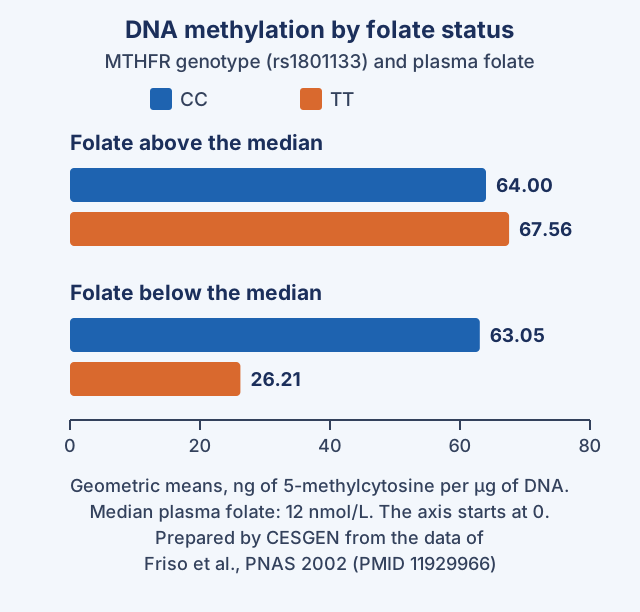
A study from Tufts University and the University of Verona measured DNA methylation in blood mononuclear cells in 292 adults from northern Italy: 105 with the TT genotype and 187 with the CC genotype. Most of them (193) were patients with coronary atherosclerosis confirmed by angiography, and the rest (99) had normal coronary arteries. Methylation was higher the higher blood folate was, and lower the higher homocysteine was, but that relationship was driven entirely by the TT group; in CC it was not significant. People with TT had the lowest methylation (geometric means of 32.23 versus 62.24 ng of 5-methylcytosine per microgram of DNA), and the difference lay in folate: above the median plasma folate (12 nmol/L), methylation was similar in both genotypes (67.56 in TT and 64.00 in CC); below it, it was 26.21 in TT versus 63.05 in CC (Friso and colleagues, 2002). It is an observational study carried out at a single point in time: it shows an association, not that changing your diet changes methylation. As an analogy with the hive, it suggests that the genotype sets the sensitivity and the folate level goes along with the result.
Genotype and diet: what the evidence says
The table summarises results from groups of people and does not necessarily predict your own case. Genotypes are named as in the papers (CC, CT, TT) and, in brackets, as you will see them in a forward-strand genetic file.
| Your MTHFR genotype (rs1801133) | What has been observed | What you can do |
|---|---|---|
| CC (GG in the file) | DNA methylation of 62.24 ng/µg (geometric mean), similar with high or low folate (64.00 and 63.05), without the drop linked to low blood folate seen in TT (Friso and colleagues, 2002). Extra riboflavin did not change homocysteine in this genotype in a trial (see the vitamin B2 post). | Your enzyme works normally: meet the reference intake for folate (330 µg of dietary folate equivalents a day for adults; EFSA, 2014) and for vitamin B2 (1.6 mg a day; EFSA, 2017) with a varied diet. You do not need to prioritise these nutrients because of your genotype. |
| CT (GA or AG) | The methylation study did not include this genotype (Friso and colleagues, 2002). In the riboflavin trials it behaved like CC (see the vitamin B2 post). | With one copy of the variant, the sensible approach is the same as for CC: meet your folate and B2 needs from your diet, and rely more on your test results than on your genotype to decide whether anything needs checking. |
| TT (AA) | Methylation of 32.23 ng/µg (geometric mean), lower than in CC: 26.21 with plasma folate below 12 nmol/L and 67.56 above it (association seen in a single study; Friso and colleagues, 2002). In trials, riboflavin lowered homocysteine and, in people with hypertension, blood pressure (see the vitamin B2 post). | Make B2 a daily habit (milk or yoghurt, eggs, mushrooms, almonds): in your genotype, riboflavin lowered homocysteine in trials. And, as something to try and observe, make sure you meet the folate reference intake every day (pulses, green leafy vegetables): in your genotype, lower methylation was linked to low folate, although it has not been shown that eating more folate changes it. If you have been told your homocysteine is high or your blood pressure is raised, mention it to your health professional together with your genotype. |
On the levels of evidence: meeting the reference intakes for folate and B2 from food is an established population recommendation (EFSA) and the base of all three rows. What is more, the folate reference intake already includes a margin, a coefficient of variation of 15%, for the higher folate requirement of people with the 677TT genotype (EFSA, 2014). The daily priority for B2 in the TT genotype rests on the homocysteine and blood pressure trials described in the vitamin B2 post (‘Replicated association, uncertain clinical utility’); those trials did not measure methylation. That the TT genotype has lower methylation when blood folate is low comes from a single observational study (‘Exploratory, not actionable’): that is why looking after folate in TT is framed as something to try and observe, without promising an effect on methylation or suggesting that you have it measured.
If you have a genetic file
If your file is from 23andMe or AncestryDNA, look for rs1801133 (the steps are in the genetic file guide). This post uses the letters of the forward strand of the reference genome, the one used by dbSNP: because MTHFR is read on the reverse strand, you will see G and A where the papers write C and T. Check the header or documentation of your file to see which strand it uses before applying the table.
| What you will see in your file | What this post calls it | What has been observed |
|---|---|---|
| rs1801133: GG | CC genotype | Methylation without the drop linked to low folate |
| rs1801133: GA or AG | CT genotype | Not studied in the methylation paper |
| rs1801133: AA | TT genotype | Lower methylation when folate is low |
| Any other combination, or dashes or zeros | Cannot be determined from this file | Check the strand and format before interpreting |
Your file's chip may not include this variant. This table describes what has been observed in studies and does not replace an assessment by a health professional.
What to bear in mind when applying it
A bee is not a person. The hive example helps to understand the idea that food changes how genes are used, not to transfer its mechanisms to people. Royal jelly does not turn anyone into a queen, and this post does not recommend it as a supplement.
The hive's mechanisms are still debated. That food decides caste is well established; whether it does so through methylation or through one particular protein has been questioned (Buttstedt and colleagues, 2016; Oldroyd and Yagound, 2021).
Methylation in blood is a marker. Friso and colleagues measured global DNA methylation in blood cells at a single point in time, in adults from one area of northern Italy, most of them patients with coronary disease. There is no methylation test today that can be used to decide what to eat, and this post does not suggest having one.
This post does not recommend supplements based on a variant. The recommendation on folic acid before pregnancy is aimed at everyone who is planning to or could become pregnant, without distinguishing genotypes (US Preventive Services Task Force, 2023), and the specific advice comes from your health professional. Changing the form of folate or taking high doses because of a genetic result is not supported by anything described here.
What you can do with this information
Meet your folate and B2 needs from food. The European reference intakes for adults are 330 µg of dietary folate equivalents a day (EFSA, 2014) and 1.6 mg of riboflavin a day outside pregnancy and breastfeeding (EFSA, 2017). A diet with pulses, green leafy vegetables, dairy, eggs and nuts helps to cover both: according to the USDA tables, 100 g of cooked lentils provides 181 µg of dietary folate equivalents and 100 g of raw spinach, 194 µg.
Give them the priority that matches your genotype. With CC or CT, meeting the reference intakes with a varied diet is enough. With TT, make B2 a daily habit and, as something to try, do not leave folate to chance; mention your genotype to your health professional if your homocysteine or blood pressure is high.
Read science the way a researcher does. The royalactin story teaches you to be wary of the ‘miracle ingredient’ and to wait for a result to be repeated. It is the same rule we apply to every variant on this blog.
The hive shows it with a clarity that is hard to match: genes set the possibilities and food decides which ones are used. Your genotype does not decide for you, but it tells you which nutrient deserves more attention.
Sources
- Nutritional control of reproductive status in honeybees via DNA methylation, Kucharski R et al. Science 319:1827-1830 (PMID 18339900), 2008
- The honey bee epigenomes: differential methylation of brain DNA in queens and workers, Lyko F et al. PLoS Biology 8:e1000506 (PMID 21072239), 2010
- Royalactin induces queen differentiation in honeybees, Kamakura M. Nature 473:478-483 (PMID 21516106), 2011
- Royalactin is not a royal making of a queen, Buttstedt A et al. Nature 537:E10-E12 (PMID 27652566), 2016
- Beyond Royalactin and a master inducer explanation of phenotypic plasticity in honey bees, Maleszka R. Communications Biology 1:8 (PMID 30271895), 2018
- The role of epigenetics, particularly DNA methylation, in the evolution of caste in insect societies, Oldroyd BP, Yagound B. Philosophical Transactions of the Royal Society B 376:20200115 (PMID 33866805), 2021
- A common mutation in the 5,10-methylenetetrahydrofolate reductase gene affects genomic DNA methylation through an interaction with folate status, Friso S et al. Proceedings of the National Academy of Sciences 99:5606-5611 (PMID 11929966), 2002
- Scientific Opinion on Dietary Reference Values for folate, EFSA Panel on Dietetic Products, Nutrition and Allergies (NDA). EFSA Journal 12(11):3893, 2014
- Dietary Reference Values for riboflavin, EFSA Panel on Dietetic Products, Nutrition and Allergies (NDA). EFSA Journal 15(8):e04919 (PMID 32625611), 2017
- Folic Acid Supplementation to Prevent Neural Tube Defects: US Preventive Services Task Force Reaffirmation Recommendation Statement, US Preventive Services Task Force. JAMA 330:454-459 (PMID 37526713), 2023
- USDA FoodData Central, SR Legacy: folate in cooked lentils (FDC 172421) and raw spinach (FDC 168462), US Department of Agriculture, accessed 16/11/2026, 2019
Educational content from CESGEN, based on the evidence published up to the review date. It does not replace individual medical or dietary advice: to apply it to your own case, talk it through with your health professional. Nutrigenetics is an evolving field, and we review each piece when the evidence changes.