Is your diet giving you enough vitamin B2?
The MTHFR enzyme needs vitamin B2. What the evidence says about its commonest variant, homocysteine and blood pressure, and which foods supply B2.
The MTHFR enzyme works alongside vitamin B2 (riboflavin), and that has a practical consequence for anyone who carries the commonest variant of its gene: in people with two copies (the TT genotype), raised homocysteine appears mainly when vitamin B2 is running low, and the risk of high blood pressure was clearly higher with deficient riboflavin. In trials, adding riboflavin to the diet lowered homocysteine and, in patients with cardiovascular disease or hypertension, blood pressure. The base is simple and applies to everyone: make sure you get vitamin B2 from ordinary foods (milk and dairy, eggs, mushrooms, almonds) up to the European reference intake for adults who are not pregnant or breastfeeding, 1.6 mg a day. And the genotype fine-tunes the emphasis: with two copies of the variant (TT), keeping good B2 status matters more, because it is the group in which riboflavin status was associated with homocysteine and with blood pressure; with CC or CT, the trials saw no response to additional riboflavin, and a varied diet that meets that reference is the way to go.
One letter, one change
The MTHFR gene, on chromosome 1, makes the enzyme methylenetetrahydrofolate reductase, which produces the form of folate the body uses to turn homocysteine into methionine (Frosst and colleagues, 1995). The best-studied variant is rs1801133: in the gene, a C becomes a T, and the alanine at position 222 of the protein is replaced by a valine (Ala222Val; in the classic literature it is called C677T). It is a common variant, and its frequency differs a great deal between populations: the T allele appears in 37% of European chromosomes, 30% of East Asian ones and 9% of African ones, and reaches 47% in the American-ancestry group of the 1000 Genomes Project. Two copies (TT) are found in 8% of Norwegian adults and 12% of Irish adults (Hustad and colleagues, 2007; Ward and colleagues, 2020).
One quirk to know when reading your file: the MTHFR gene is read in the opposite direction to the forward strand of the reference genome, so in dbSNP and in forward-strand files this variant appears as G>A, not C>T. The papers use the letters of the gene, C and T; this entry always gives both forms. There is a second well-known variant, rs1801131 (A1298C, Glu429Ala): in the laboratory, the protein carrying it has properties indistinguishable from the usual enzyme (Yamada and colleagues, 2001), so this entry concentrates on rs1801133.
The mechanism, step by step
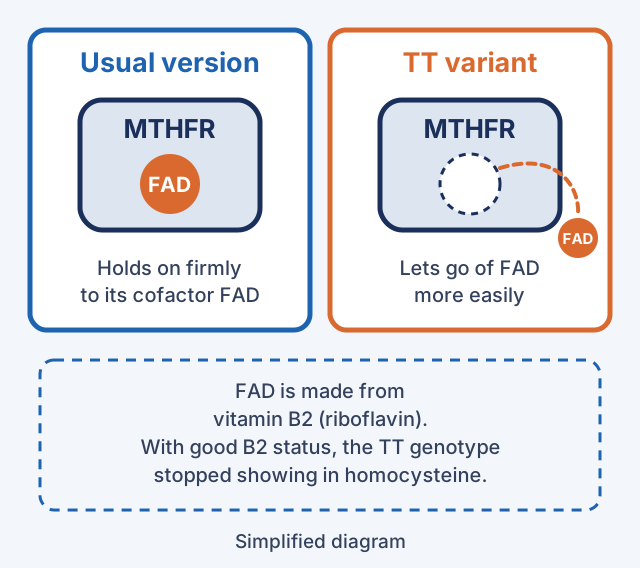
1. The enzyme needs a partner. MTHFR converts one type of folate, 5,10-methylenetetrahydrofolate, into 5-methyltetrahydrofolate, the most abundant form of folate in the blood and the one that supplies the carbon for turning homocysteine into methionine (Frosst and colleagues, 1995). To work it uses a cofactor, FAD, which is made from riboflavin (Guenther and colleagues, 1999; McNulty and colleagues, 2006).
2. The variant holds it less firmly. Frosst and colleagues saw that people with the variant had less enzyme activity and an enzyme that was more sensitive to heat. With human enzyme produced in the laboratory, the valine version is more inclined to split into its subunits and lose FAD, and the loss of activity is slowed by folate (Yamada and colleagues, 2001; Guenther and colleagues, 1999).
3. Less activity, more homocysteine. With less activity, more homocysteine is left untransformed: TT people have more homocysteine in their blood (Frosst and colleagues, 1995). In 10,601 Norwegian adults, the average was 10.4 µmol/L in CC, 10.9 in CT and 13.3 in TT (Hustad and colleagues, 2007).
4. Vitamin B2 changes the result. In 286 healthy adults aged 19 to 63, the high homocysteine of the TT genotype was concentrated in the third with the poorest riboflavin status (18.1 µmol/L on average, almost double that of CC or CT), and with adequate status the TT group was neutral (McNulty and colleagues, 2002). In the Norwegian study, in TT people the difference in homocysteine between the quarter with the least vitamin and the quarter with the most was 5.4 µmol/L for folate, 4.1 for riboflavin, 3.2 for B12 and 2.1 for B6 (Hustad and colleagues, 2007).
How sure are we? That the variant loses its cofactor more easily is very well established in the laboratory. That the homocysteine of TT people depends on B2 status has been seen in population studies and in a randomised trial. That this carries over to blood pressure has been seen in trials from a single group and in one population study, and it still needs confirming in other groups, as explained below.
Genotype and diet: what the evidence says
The practical question is whether your genotype changes what it is worth eating. What has been published lets us answer on two fronts: homocysteine and blood pressure. The table describes what was observed in studies, in groups of people, and not anyone's individual case. Genotypes are named as in the papers (CC, CT, TT) and, in brackets, as you would see them in a genetic file (forward-strand letters).
| Your genotype | What has been observed | What you can do | Evidence |
|---|---|---|---|
| CC (GG in the file) | Average homocysteine of 10.4 µmol/L in 10,601 adults (Hustad and colleagues, 2007). In a trial, 1.6 mg a day of riboflavin for 12 weeks did not change their homocysteine (McNulty and colleagues, 2006), and riboflavin status did not alter their risk of hypertension (Ward and colleagues, 2020). | Your enzyme works normally and, in the trial, additional riboflavin did not change the homocysteine of this genotype: meet the reference intake of riboflavin with a varied diet (1.6 mg a day for adults who are not pregnant or breastfeeding; EFSA, 2017) and you do not need to prioritise B2 because of your genotype. | Replicated association, uncertain clinical utility |
| CT (GA or AG) | Average homocysteine of 10.9 µmol/L (Hustad and colleagues, 2007). No homocysteine response to riboflavin in the trial (McNulty and colleagues, 2006) and no difference in hypertension risk by riboflavin status (Ward and colleagues, 2020). | Your intermediate genotype did not respond to additional riboflavin in the trial either: meet the reference intake with a varied diet, as in CC, and let your blood pressure and your tests, rather than your genotype, show whether there is anything else to look at. | Replicated association, uncertain clinical utility |
| TT (AA) | Average homocysteine of 13.3 µmol/L (Hustad and colleagues, 2007), with the rise concentrated in people with little B2 (18.1 µmol/L in the third with the poorest status; McNulty and colleagues, 2002). In trials, 1.6 mg a day of riboflavin lowered homocysteine (McNulty and colleagues, 2006) and, in patients with premature cardiovascular disease or treated hypertension, blood pressure (Horigan and colleagues, 2010; Wilson and colleagues, 2013). | Prioritise B2 sources every day (milk or yoghurt, eggs, mushrooms, almonds) to keep good riboflavin status, which is what was associated with lower homocysteine and lower risk of hypertension; check your blood pressure regularly and, if it is high or your homocysteine has been measured as raised, discuss your genotype and your diet with your health professional. | Replicated association, uncertain clinical utility |
Homocysteine
In a randomised trial with 35 TT, 26 CT and 28 CC people (chosen from a register of 680 healthy adults aged 18 to 65 with known genotype), riboflavin (1.6 mg a day for 12 weeks) was compared with placebo. Only the TT genotype responded: homocysteine fell by as much as 22% overall (from 16.1 to 12.5 µmol/L) and by 40% in those who started with lower riboflavin status (from 22.0 to 13.2). CC and CT showed no response, even though people with less-than-optimal riboflavin had been selected (McNulty and colleagues, 2006).
Blood pressure
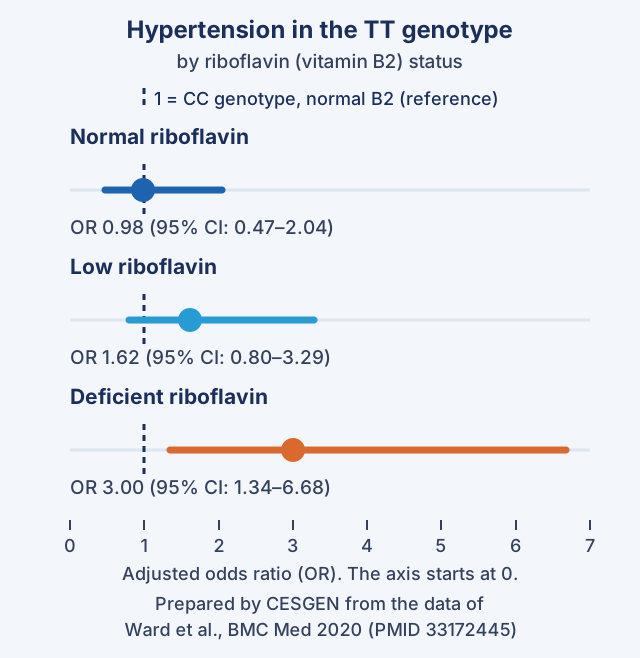
In 6,076 adults aged 18 to 102 from Ireland and the United Kingdom, the TT genotype was present in 12%. In the 2,575 participants aged 18 to 70, it was associated with an average systolic blood pressure of 137.6 mmHg against 135.0 in CC (adjusted values) and, in the hypertension analysis for that age group, with a higher risk (OR 1.42; 95% confidence interval, 1.07 to 1.90). Riboflavin status modified that risk only in the TT genotype: with normal riboflavin there was no excess risk (OR 0.98), with low riboflavin it was 1.62 and with deficient riboflavin it was 3.00, in each case against the CC genotype with normal riboflavin. Low riboflavin was found in 30.2% of participants and deficient riboflavin in 30.0% (Ward and colleagues, 2020).
The randomised trials point the same way. In patients with premature cardiovascular disease, 1.6 mg a day of riboflavin for 16 weeks lowered blood pressure only in those with the TT genotype (from 144/87 to 131/80 mmHg; Horigan and colleagues, 2010). In 91 TT people with treated hypertension, the same supplement lowered systolic blood pressure by 5.6 mmHg more than placebo (Wilson and colleagues, 2013).
What are these recommendations based on?
The base is the reference intake, which already takes this genotype into account: the EFSA panel considered that the effect of the TT genotype on riboflavin requirements is covered by the data from the studies it based the reference intake on and by the margin of variability it applied, and at the same time noted that TT can increase individual requirements, without being able to say by how much, and that this polymorphism should be considered when setting requirements (EFSA, 2017). On that base, the recommendation changes the emphasis according to what was seen: only TT people responded to riboflavin, so for them keeping good B2 status matters more, and for CC and CT it is enough to meet the reference. How much riboflavin each person needs cannot be pinned down from the genotype, and this entry does not propose a supplement because of it.
On the levels of evidence: meeting the reference intake of B2 from food is an established population recommendation (EFSA) and the base of all three rows; what each genotype adds — that TT responds to riboflavin in homocysteine and blood pressure and that CC and CT did not respond in the trial — has been seen in several trials and studies, but almost all from one group and, for blood pressure, in patients with hypertension or cardiovascular disease (‘Replicated association, uncertain clinical utility’). The dose used in the trials is not turned into a personal recommendation.
Where is vitamin B2?
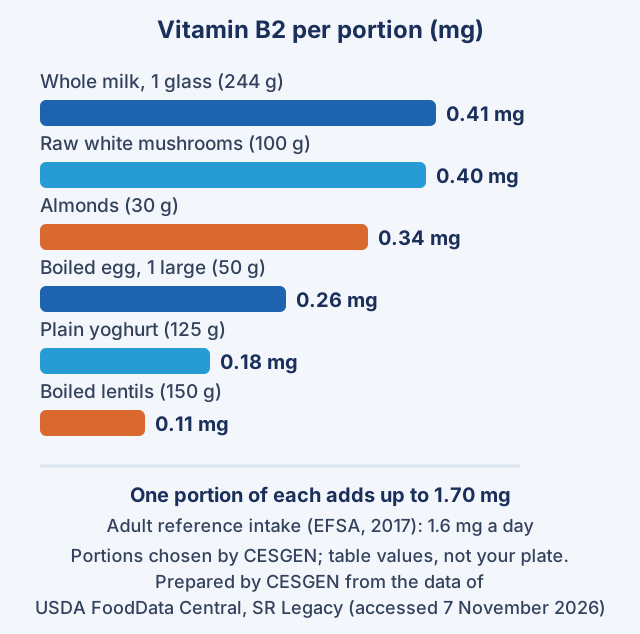
According to the European nutrient composition database that EFSA cites, the main dietary sources of riboflavin are milk, dairy products, eggs and offal, and dairy contributes most in Western diets (EFSA, 2017). In the USDA tables, a portion of milk, mushrooms or almonds provides between 0.34 and 0.41 mg, and one portion of each of the six foods in the figure adds up to 1.70 mg, above the reference intake of 1.6 mg a day for adults who are not pregnant or breastfeeding. There is no need to eat them all every day: it is a sample showing that a varied diet can meet it.
If you have a genetic file
If your file is from 23andMe or AncestryDNA, look for rs1801133 and, if you wish, rs1801131 (the steps are in the genetic file guide). This entry uses the letters of the forward strand of the reference genome (the dbSNP one). Because MTHFR is on the reverse strand, they do not match the papers: at rs1801133 you will see G and A where the papers write C and T, and at rs1801131 you will see T and G where they write A and C. Check the header or the documentation of your file to see which strand it uses before applying the table. If your file were on the other strand, you would see C and T directly at rs1801133, and A and C at rs1801131: the same letters the papers use, and the names in the table would match what you see.
| What you will see in your file | What this entry calls it | What has been observed |
|---|---|---|
| rs1801133: GG | CC genotype (677CC) | No homocysteine response to riboflavin in the trial |
| rs1801133: GA or AG | CT genotype | The same as CC in the trial; average homocysteine of 10.9 against 10.4 µmol/L |
| rs1801133: AA | TT genotype | Higher homocysteine when B2 is low; riboflavin lowered it and, in people with hypertension, lowered blood pressure |
| rs1801131: TT, TG or GG | 1298AA, 1298AC or 1298CC genotype | Protein with properties indistinguishable from the usual one in the laboratory; this entry draws no advice from it |
| Any other combination (for example a C next to a G, or dashes or zeros) | Cannot be determined with this file | Check the strand and format of your file before interpreting |
Three more warnings. The chip behind your file may not include one of these variants; if you cannot find it, check whether your chip and file format include it. If it appears with dashes or zeros instead of letters, check how your file marks positions that were not read. And no variant tells you how much vitamin B2 you need. This table describes what has been observed in studies and does not replace the assessment of a health professional.
What to bear in mind when applying it
The riboflavin trials come from a single group. Those of McNulty, Horigan and Wilson come from the same research group (Ulster University). The blood pressure trials were done in patients with premature cardiovascular disease (Horigan) and with treated hypertension (Wilson), and the authors themselves call for the effect to be confirmed in people without hypertension (Ward and colleagues, 2020). As a competing interest, five authors of that group (Ward, McNulty, Strain, Horigan and Scott) are named on a patent, granted in Europe and pending elsewhere, on the use of riboflavin in the treatment of hypertension, as declared by Ward and colleagues (2020). Population studies, such as those of Hustad, McNulty (2002) and Ward, show associations: they do not prove that one thing causes the other.
This result is not a routine test. In 2013, the American College of Medical Genetics concluded that testing for this polymorphism has minimal clinical utility and should not be ordered routinely when evaluating thrombophilia (Hickey and colleagues, 2013). And in a meta-analysis of 40 studies (11,162 cases and 12,758 controls), the TT genotype was associated with 16% higher odds of coronary heart disease (OR 1.16), with differences between Europe (1.14) and North America (0.87) that the authors relate to folate status (Klerk and colleagues, 2002). That is why its value here is to guide eating, not to assess anyone's risk.
The genotype adds to other nutrients. Homocysteine also depends on folate, B12 and B6 (Hustad and colleagues, 2007), and having low or deficient riboflavin is common: 30.2% and 30.0% of participants respectively in the study from Ireland and the United Kingdom (Ward and colleagues, 2020).
Pregnancy has its own guidance. During pregnancy and breastfeeding, EFSA sets different reference intakes for riboflavin, of 1.9 and 2.0 mg a day respectively (EFSA, 2017). The recommendation on folic acid before pregnancy is addressed to everyone who is planning a pregnancy or could become pregnant (US Preventive Services Task Force, 2023). This entry does not propose changing it, or changing the form of folate because of a genetic result: your health professional gives that advice.
Populations differ. The studies cited come mainly from Ireland, the United Kingdom and Norway, and the frequency of the TT genotype differs a great deal between populations.
This entry does not recommend supplements because of a variant. In the trials, participants received 1.6 mg of riboflavin a day on top of their diet, the same figure as the European reference intake for adults outside pregnancy and breastfeeding (EFSA, 2017). It is a fact from those studies, not personal advice.
What you can do with this information
Get your B2 from food. Milk and dairy, eggs and offal are the main sources (EFSA, 2017), and according to the USDA tables mushrooms and almonds also provide similar amounts per portion. The reference intake, 1.6 mg a day, is the same for all adults who are not pregnant or breastfeeding, whatever the genotype.
Fine-tune the emphasis for your genotype. If you are CC or CT, meeting the reference with a varied diet is the way to go, and you do not need to prioritise B2 because of your genotype. If you are TT, make B2 sources a daily habit, check your blood pressure regularly and, if it is high or your homocysteine has been measured as raised, tell your health professional.
Vary your diet. Homocysteine depends on several vitamins that work together, folate, B12 and B6 as well as B2 (Hustad and colleagues, 2007): a varied diet covers more than one at a time.
If you have high blood pressure or have been told your homocysteine is raised, tell your health professional. Tell them your genotype too, if you know it, and how you eat: it is a clue that can help them decide what to look at. The trials used a supplement, and that decision is theirs.
Ask for interpretation with context. If you have your genotype, read it alongside your diet, your blood pressure and your blood tests, with your health professional: that way it becomes a useful clue and not a label.
This is how genetic information improves eating: it does not decide for you, but it tells you which nutrient deserves more attention.
Sources
- A candidate genetic risk factor for vascular disease: a common mutation in methylenetetrahydrofolate reductase, Frosst P et al. Nature Genetics 10:111-113 (PMID 7647779), 1995
- The structure and properties of methylenetetrahydrofolate reductase from Escherichia coli suggest how folate ameliorates human hyperhomocysteinemia, Guenther BD et al. Nature Structural Biology 6:359-365 (PMID 10201405), 1999
- Effects of common polymorphisms on the properties of recombinant human methylenetetrahydrofolate reductase, Yamada K et al. Proceedings of the National Academy of Sciences 98:14853-14858 (PMID 11742092), 2001
- Impaired functioning of thermolabile methylenetetrahydrofolate reductase is dependent on riboflavin status: implications for riboflavin requirements, McNulty H et al. American Journal of Clinical Nutrition 76:436-441 (PMID 12145019), 2002
- Riboflavin lowers homocysteine in individuals homozygous for the MTHFR 677C->T polymorphism, McNulty H et al. Circulation 113:74-80 (PMID 16380544), 2006
- The methylenetetrahydrofolate reductase 677C->T polymorphism as a modulator of a B vitamin network with major effects on homocysteine metabolism, Hustad S et al. American Journal of Human Genetics 80:846-855 (PMID 17436239), 2007
- Riboflavin lowers blood pressure in cardiovascular disease patients homozygous for the 677C->T polymorphism in MTHFR, Horigan G et al. Journal of Hypertension 28:478-486 (PMID 19952781), 2010
- Blood pressure in treated hypertensive individuals with the MTHFR 677TT genotype is responsive to intervention with riboflavin: findings of a targeted randomized trial, Wilson CP et al. Hypertension 61:1302-1308 (PMID 23608654), 2013
- Impact of the common MTHFR 677C->T polymorphism on blood pressure in adulthood and role of riboflavin in modifying the genetic risk of hypertension: evidence from the JINGO project, Ward M et al. BMC Medicine 18:318 (PMID 33172445), 2020
- Dietary Reference Values for riboflavin, EFSA Panel on Dietetic Products, Nutrition and Allergies (NDA). EFSA Journal 15(8):e04919 (PMID 32625611), 2017
- MTHFR 677C->T polymorphism and risk of coronary heart disease: a meta-analysis, Klerk M et al. JAMA 288:2023-2031 (PMID 12387655), 2002
- ACMG Practice Guideline: lack of evidence for MTHFR polymorphism testing, Hickey SE et al. Genetics in Medicine 15:153-156 (PMID 23288205), 2013
- Folic Acid Supplementation to Prevent Neural Tube Defects: US Preventive Services Task Force Reaffirmation Recommendation Statement, US Preventive Services Task Force. JAMA 330:454-459 (PMID 37526713), 2023
- USDA FoodData Central, SR Legacy: riboflavin in whole milk, plain yoghurt, boiled egg, raw white mushrooms, almonds and boiled lentils, US Department of Agriculture, accessed 7 November 2026, 2019
- Ensembl and dbSNP, rs1801133 and rs1801131: alleles, forward strand, consequence in the canonical transcript and 1000 Genomes frequencies (GRCh38), NCBI dbSNP and Ensembl, accessed 7 November 2026, 2026
Educational content from CESGEN, based on the evidence published up to the review date. It does not replace individual medical or dietary advice: to apply it to your own case, talk it through with your health professional. Nutrigenetics is an evolving field, and we review each piece when the evidence changes.