Does broccoli taste bitter? It may be your genes
A taste receptor in two common versions helps explain why broccoli tastes different from person to person. How it works, plus kitchen tricks.
If broccoli or Brussels sprouts taste different to you than they do to other people, part of the explanation may lie in a receptor on your tongue, and there are ways of cooking them that can make you enjoy them more. A gene, TAS2R38, comes in two common versions, and one of them responds more strongly to the bitter compounds in cruciferous vegetables. Understanding this gives you kitchen tools to enjoy these vegetables more, and it is one of the cases where the mechanism can be followed from start to finish, from the DNA letter to the sensation in your mouth.
Three letters, two versions
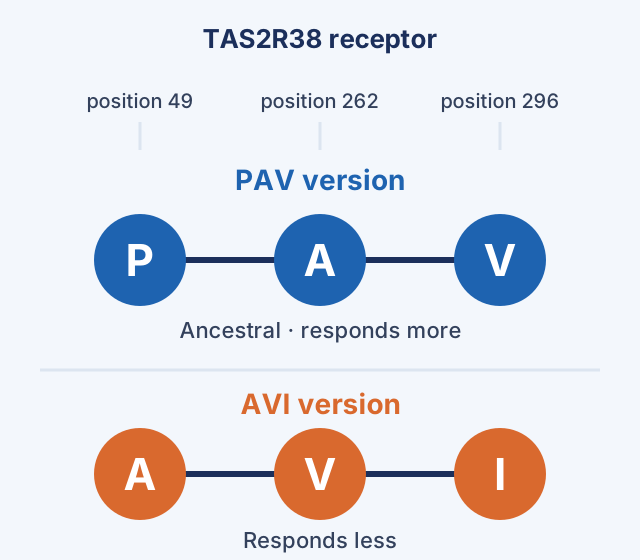
TAS2R38 is a gene on chromosome 7 that makes a bitter taste receptor. Kim and colleagues (2003) located it while looking for the origin of a difference that had been known for decades: a laboratory substance, phenylthiocarbamide (PTC), tastes very bitter to some people and barely at all to others. In the gene they found three variants that change one amino acid of the protein, at positions 49, 262 and 296, and that combine into five haplotypes. These combinations fully account for the split into two groups in sensitivity to PTC, and for 55% to 85% of its variation.
The two common combinations are called PAV and AVI, after the initial of the amino acid they carry at each position: proline, alanine and valine in the first; alanine, valine and isoleucine in the second. Across the world's populations they average 51% and 43% (Risso and colleagues, 2016), so the usual picture is three genotypes: PAV/PAV, PAV/AVI and AVI/AVI. The PAV version is the ancestral one: the genomes of Neanderthals and Denisovans belong to its group.
What the receptor does
Bitter taste receptors are proteins on the surface of taste cells that switch on when a molecule fits into them. We have around 25 different types (Hayes and colleagues, 2013), each sensitive to a group of compounds. TAS2R38 responds to those that contain the N–C=S group (Bufe and colleagues, 2005): besides PTC and another laboratory substance, propylthiouracil (PROP), there are natural plant compounds, such as goitrin. The glucosinolates of cruciferous vegetables count too: in cooked cauliflower, two of them, sinigrin and neoglucobrassicin, account for the bitterness (Engel and colleagues, 2002), and the review by Hayes notes that sinigrin contains that group and activates TAS2R38.
The mechanism, step by step
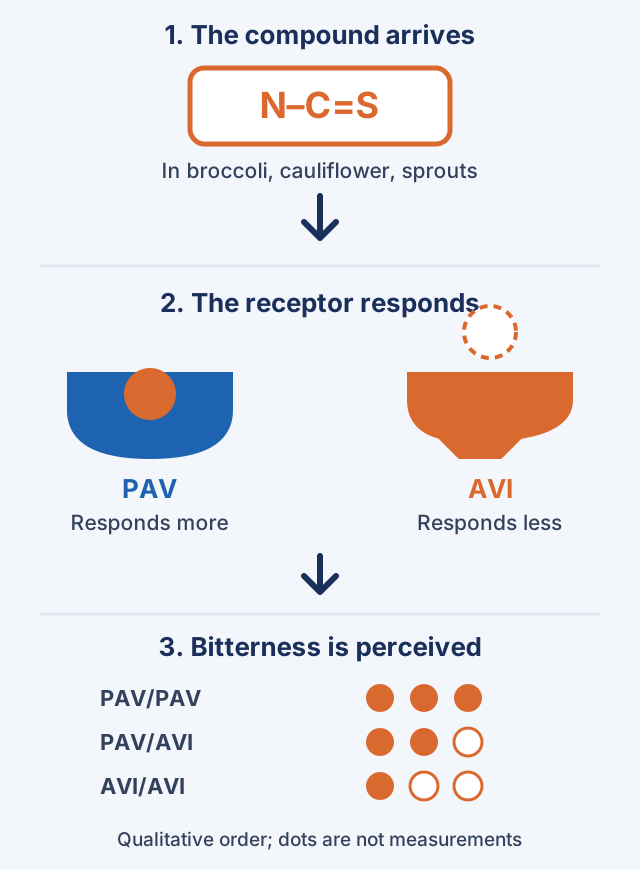
1. The compound reaches the tongue. When you chew broccoli, cauliflower or Brussels sprouts, compounds with the N–C=S group are released.
2. The two versions of the receptor do not respond in the same way. Bufe and colleagues (2005) expressed all five haplotypes in cells and found that they are functionally different receptors. For three of them, the receptor's response in the laboratory also matched what people with that haplotype perceived. Of the two common versions, PAV responds more and AVI appears to be less functional.
3. The sensation follows the same order. In the work of Sandell and Breslin (2006), as summarised by Duffy and colleagues (2010) and Hayes and colleagues (2013), vegetables containing glucosinolates tasted more bitter to PAV/PAV people than to PAV/AVI people, and to these more than to AVI/AVI people. For vegetables without glucosinolates there were no differences between genotypes. That specificity is a good sign that the receptor is what makes the difference: in the Duffy study, for example, the bitterness of quinine did not vary with TAS2R38 genotype.
How sure are we? The link between the variants and sensitivity to PTC and PROP is very solid, and so is the finding that the two versions of the receptor respond differently in the laboratory. For vegetables in the diet, the difference in bitterness has been described in people, but it is worth reading it with the nuance in the next section: what changes is how the vegetable tastes, and there is a gap between that and what each person ends up eating.
Genotype and diet: what the evidence says
What has been described is how the bitterness of cruciferous vegetables changes with genotype. The table describes what has been observed in studies, at population level, and not anyone's individual case. The genotypes are those of the PAV and AVI haplotypes, which are identified with the three variants on the card (further down, how to read them in your file):
| Your genotype | What has been observed | What you can do | Evidence |
|---|---|---|---|
| PAV/PAV | Vegetables containing glucosinolates taste more bitter to them than to the other genotypes (Sandell and Breslin, 2006, as reported by Duffy and Hayes). | If they taste bitter to you, try the kitchen adjustments in this article: steaming or stir-frying, or boiling and draining; a touch of sweetness; salt to taste; a different variety. | Replicated association, uncertain clinical utility |
| PAV/AVI | Intermediate bitterness (Sandell and Breslin, 2006, as reported by Duffy and Hayes). | The same adjustments, if any vegetable tastes bitter to you. | Replicated association, uncertain clinical utility |
| AVI/AVI | Less bitterness in those vegetables (Sandell and Breslin, 2006, as reported by Duffy and Hayes). | The same adjustments, if any variety tastes bitter to you. | Replicated association, uncertain clinical utility |
Why is the cooking advice the same for all three genotypes? Because none of the studies cited has checked whether these adjustments work differently depending on genotype. The closest is the work of Mennella and colleagues (2015): sucrose reduced the bitterness of PROP in children and adults, and was more effective in those who were genetically more sensitive, but that difference did not reach statistical significance. A different adjustment for each genotype is, for now, exploratory and not actionable. What does change with genotype is what you are likely to notice when you taste: if you are PAV/PAV, cruciferous vegetables are more likely to taste bitter to you, and it is more likely to be worth trying these adjustments.
The effect on what people actually eat is less clear, as the next paragraph shows.
Studies that look at what people eat give mixed results. In a laboratory study of healthy adults with an average age of 26, people who were AVI/AVI reported eating more vegetables, of all types and not only the bitter ones (Duffy and colleagues, 2010). By contrast, in 3,383 British women no substantial association was found between these haplotypes and eating behaviour (Timpson and colleagues, 2005). The review by Hayes and colleagues (2013) sums it up well: a variant changing a receptor's response in the laboratory may not be enough to change what is chosen in real life.
The useful reading is that the receptor influences how certain cruciferous vegetables taste to you; how much you end up eating also depends on many other factors. And how they taste is, precisely, something you can change in the kitchen.
If you have a genetic file
To find out whether you are PAV/PAV, PAV/AVI or AVI/AVI you need all three variants, not just one. Look for rs713598, rs1726866 and rs10246939 in your 23andMe or AncestryDNA file (the steps are in the genetic file guide). This article uses the letters of the forward strand of the reference genome, the one used by dbSNP; check the header or the documentation of your file to see which strand it uses before applying the table. If your file uses the reverse strand, each letter is replaced by its complement (G↔C, A↔T). For a single variant, the order of the two letters does not matter (GC is the same as CG).
| What you will see in your file (rs713598 · rs1726866 · rs10246939) | What this article calls it |
|---|---|
| GG · GG · CC | PAV/PAV |
| GC · GA · CT | PAV/AVI (most likely if all three are heterozygous) |
| CC · AA · TT | AVI/AVI |
| Any other combination | Cannot be determined with this file |
Three points to bear in mind. If any of the three variants is missing from your file, or appears with dashes or zeros instead of letters, your haplotype cannot be determined; check how your file marks positions that were not read. There are other, less common haplotypes (for example AAI in sub-Saharan Africa), which this table does not cover. And the result describes how the bitterness of certain compounds is perceived, not how you eat or will eat. This table describes what has been observed in studies and does not replace an assessment by a healthcare professional.
A variation that has been preserved
Risso and colleagues (2016) analysed this gene in 5,589 people from 105 populations. Their simulations fit ancestral selection that kept both versions at similar proportions, and they find no signs of recent selection. The authors suggest, as a hypothesis, that both may have been useful for detecting potentially toxic bitter compounds found in Africa. It is a hypothesis about why both versions were preserved; we do not yet know what specific advantage each may have offered.
What to bear in mind when applying it
- Genotype tells you about the perception of certain compounds, not about your preferences. TAS2R38 is one of around 25 bitter taste receptors, and taste also depends on culture, habit and how food is cooked.
- There are more haplotypes than the two common ones. In African populations, for example, AAI can reach appreciable frequencies; that is why looking at a single variant can misclassify the haplotype.
- It is not a label. Being PAV or AVI says nothing about how you eat or how a child will eat; it helps you understand a sensation and decide how to cook.
What you can do with this information
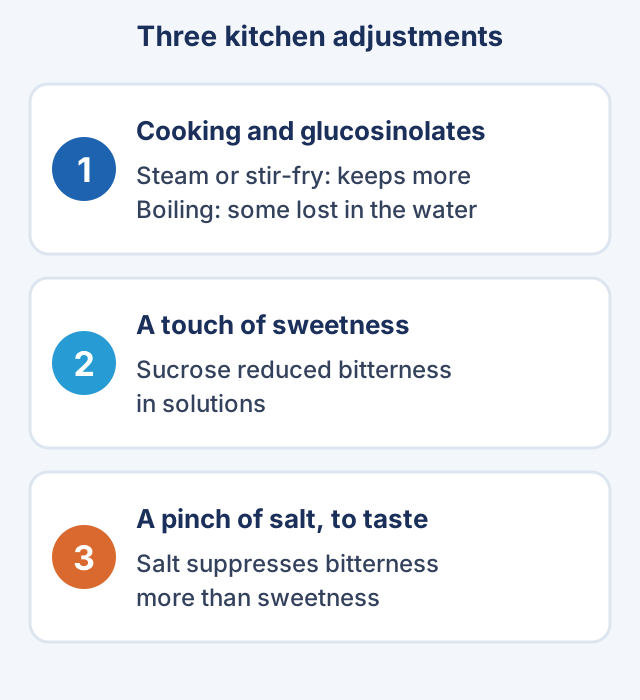
- Choose how you cook. Song and Thornalley (2007) measured that steaming, microwaving and stir-frying cause no significant losses of glucosinolates, whereas boiling loses them into the cooking water (around 90% of what was lost was in it). As glucosinolates account for the bitterness in cauliflower, boiling and draining can be expected to soften it. They did not measure that effect on flavour with tasters, and in return you lose some of those compounds. You can keep more glucosinolates by steaming or stir-frying, or try whether boiling and draining softens the flavour for you.
- Try a touch of sweetness. Mennella and colleagues (2015) found, in children and adults, that sucrose reduced the bitterness of several compounds, PROP among them. The study used sucrose in solutions, not vegetables. If you fancy it, you can try a sweet contrast, such as carrot or orange, and see whether you like the result.
- A pinch of salt, to taste. Breslin and Beauchamp (1997) presented evidence that salts suppress bitterness more than sweetness, something the cooking of many cultures takes advantage of. If you already add salt when cooking, adjust the amount to your taste; the study cited does not allow a dose to be recommended for these vegetables.
- Change variety. Across 11 varieties of cooked cauliflower, the main differences were bitterness and cauliflower smell (Engel and colleagues, 2002): if one variety does not appeal, another may suit you better.
- Run your own experiment. Prepare the same vegetable in two or three ways, note which you like best and repeat it. It is the most direct way to turn a sensation into a recipe that works for you.
This is how genetic information improves eating: it does not decide what you eat, but it explains why something tastes the way it does and gives you clues to cook it better.
Sources
- Positional cloning of the human quantitative trait locus underlying taste sensitivity to phenylthiocarbamide, Kim UK et al. Science 299:1221-1225 (PMID 12595690), 2003
- The molecular basis of individual differences in phenylthiocarbamide and propylthiouracil bitterness perception, Bufe B et al. Current Biology 15:322-327 (PMID 15723792), 2005
- Variability in a taste-receptor gene determines whether we taste toxins in food, Sandell MA, Breslin PA. Current Biology 16:R792-R794 (PMID 16979544), 2006
- Vegetable intake in college-aged adults is explained by oral sensory phenotypes and TAS2R38 genotype, Duffy VB et al. Chemosensory Perception 3:137-148 (PMID 21157576), 2010
- TAS2R38 (phenylthiocarbamide) haplotypes, coronary heart disease traits, and eating behavior in the British Women's Heart and Health Study, Timpson NJ et al. American Journal of Clinical Nutrition 81:1005-1011 (PMID 15883422), 2005
- Do polymorphisms in chemosensory genes matter for human ingestive behavior? (review), Hayes JE, Feeney EL, Allen AL. Food Quality and Preference 30:202-216 (PMID 23878414), 2013
- Global diversity in the TAS2R38 bitter taste receptor: revisiting a classic evolutionary PROPosal, Risso DS et al. Scientific Reports 6:25506 (PMID 27138342), 2016
- Flavor-active compounds potentially implicated in cooked cauliflower acceptance, Engel E et al. Journal of Agricultural and Food Chemistry 50:6459-6467 (PMID 12381134), 2002
- Effect of storage, processing and cooking on glucosinolate content of Brassica vegetables, Song L, Thornalley PJ. Food and Chemical Toxicology 45:216-224 (PMID 17011103), 2007
- "A spoonful of sugar helps the medicine go down": bitter masking by sucrose among children and adults, Mennella JA et al. Chemical Senses 40:17-25 (PMID 25381313), 2015
- Salt enhances flavour by suppressing bitterness, Breslin PA, Beauchamp GK. Nature 387:563 (PMID 9177340), 1997
- dbSNP, rs713598: alleles (forward strand of the reference genome), amino acid change of each allele and 1000 Genomes allele frequencies, NCBI dbSNP, accessed 6 November 2026, 2026
- dbSNP, rs1726866: alleles (forward strand of the reference genome), amino acid change of each allele and 1000 Genomes allele frequencies, NCBI dbSNP, accessed 6 November 2026, 2026
- dbSNP, rs10246939: alleles (forward strand of the reference genome), amino acid change of each allele and 1000 Genomes allele frequencies, NCBI dbSNP, accessed 6 November 2026, 2026
Educational content from CESGEN, based on the evidence published up to the review date. It does not replace individual medical or dietary advice: to apply it to your own case, talk it through with your health professional. Nutrigenetics is an evolving field, and we review each piece when the evidence changes.