Milk: why some people tolerate it and others don't
One DNA letter near the lactase gene is linked to digesting milk in adulthood. See how the mechanism works and how to put that knowledge to use.
If dairy sits differently with you than with other people, your DNA can give you a very useful clue. A single letter, located in a region that regulates the lactase gene, is linked in European populations to carrying on making this enzyme in adulthood. Knowing about it helps you understand your own case and decide with confidence how to include dairy in your diet, rather than cutting it out blindly. It is also one of the best-studied mechanisms linking a gene to a nutrient, and well worth following step by step.
One letter, one change
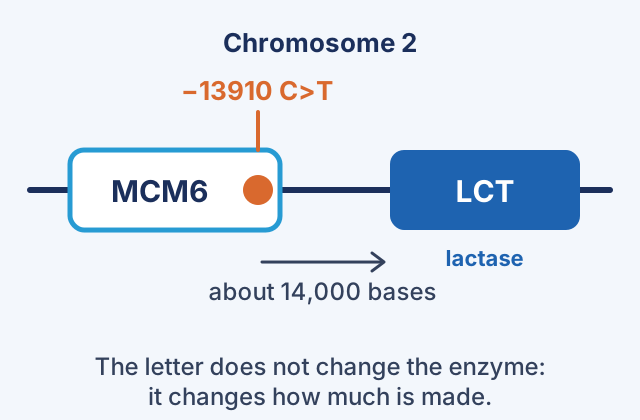
The variant is called rs4988235 and is also known by its position, −13910 C>T: about 13,910 bases before the start of the lactase gene (LCT), a C can be a T. Each person carries two copies of the genome, so there are three possible combinations: CC, CT and TT.
What is surprising is where it sits. The variant is not inside the lactase gene but in a neighbouring gene, MCM6. This is how Enattah's team located it in 2002, studying Finnish families: the C/T−13910 variant coincided completely with lactase non-persistence measured biochemically, in those families and in 236 people from four different populations.
What lactase does
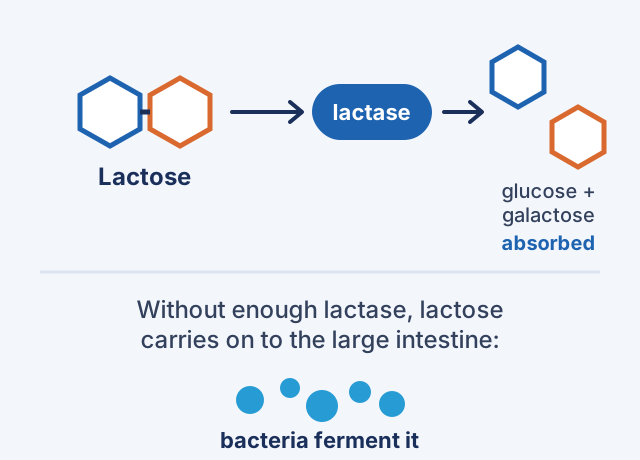
Lactose is the sugar in milk: two smaller sugars, glucose and galactose, joined together. Joined like this, they cannot cross the wall of the gut. Lactase, an enzyme on the surface of the small intestine, cuts that link, and the glucose and galactose are absorbed.
When there is little lactase, some of the lactose carries on to the large intestine. There, bacteria ferment it, producing gas and acids and drawing in water. This is where the bloating, the rumbling and, sometimes, the diarrhoea that many people associate with lactose intolerance come from.
In most mammals, and in most people in the world, lactase production falls after weaning. This is the original state of our species. What is exceptional is keeping it high into adulthood, and that is where the variant comes in.
The mechanism, step by step
1. The variant's region is an enhancer. An enhancer is a stretch of DNA that, without being part of the gene, boosts its activity. In cultured intestinal cells, the −13910 region works as an enhancer of the lactase gene, and the version with T switches it on more than the version with C: about four times more in the work of Troelsen and colleagues (2003). Olds and Sibley (2003) observed the same direction of effect with a different experimental system.
2. The T attracts a regulatory protein more strongly. Proteins from the cell nucleus bind much better to the version with T than to the version with C. Lewinsky and colleagues (2005) identified one of them: Oct-1, a transcription factor that bound directly to the sequence with T. In their assays, Oct-1 increased the gene's activity together with another intestinal factor, HNF1α, and the region turned out to have binding sites for other intestinal regulators, three of them necessary for its enhancer effect. The authors proposed this mechanism as the explanation for lactase persistence.
3. In the human gut, more lactase RNA. Kuokkanen and colleagues (2003) observed this in intestinal biopsies from 14 people with one copy of each version: the copy carrying the persistence combination (T at −13910 and A at another nearby position, −22018) supplied on average 92% of the lactase messenger RNA. The result shows the difference in expression in human tissue, although it does not separate the effect of the two variants.
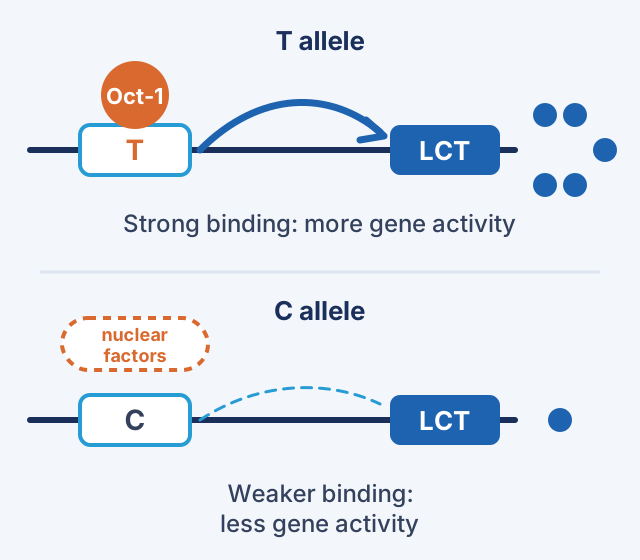
This has a practical consequence. In many European populations, a single T is usually enough to keep lactase active, so the CT genotype should not automatically be read as a midpoint. That said, the genotype does not predict the exact level of activity or the amount of lactose each person tolerates.
How sure are we? The association between the variant and lactase persistence is very solid in Europe. Steps 1 and 2 have been shown in cultured cells, and the difference in expression in step 3 in human intestinal tissue. The role of Oct-1 is the best-supported explanation, and its authors present it as the proposal that fits the data, not as the last word.
A solution that arose more than once
The same idea arose independently in other cattle-herding populations. Tishkoff and colleagues (2007) studied 470 people from Tanzania, Kenya and Sudan and found three variants different from the European one (−14010, −13915 and −13907), in the same regulatory region, which also increase the activity of the lactase gene in the laboratory. Each arose on its own, and the most studied shows the signature of intense selection over roughly the last 7,000 years. It is a textbook example of convergent evolution: the same cultural habit, milking animals and drinking milk, and several genetic solutions to the same problem.
Genotype and diet: what the evidence says
Lactase is the best-studied case in this series: here the genotype does point the way. The table describes what has been observed in studies, at population level, and not anyone's individual case. Genotypes are named as in the scientific papers (−13910 C and T) and, in brackets, with the letters of the forward strand of the reference genome, which are the ones you will see in a file that uses that strand:
| Your genotype | What has been observed | What you can do | Evidence for the genetic finding |
|---|---|---|---|
| CC (in the file, GG) | In people of European ancestry, lactase usually falls after weaning. | Try small portions of dairy with other foods, spread through the day; natural yogurt and mature cheeses usually sit better; lactose-free milk is an alternative. | Established clinical application (in European ancestry) |
| CT (GA) | In many European populations, a single T is enough to keep lactase active. | No restriction because of the genotype. If you have symptoms, discuss them with your healthcare professional. | Established clinical application (in European ancestry) |
| TT (AA) | Lactase is expected to stay active in adulthood. | No restriction because of the genotype. If you have symptoms, discuss them with your healthcare professional. | Established clinical application (in European ancestry) |
The evidence column rates only the genetic finding. The advice on dairy is general, symptom-guided advice, not a recommendation established by genotype.
Why these recommendations? Tolerance to lactose depends on the amount, on lactase activity and on the gut microbiota (Misselwitz and colleagues, 2019). According to that review, most people with lactose malabsorption tolerate a small serving of milk without problems, and better still if they have it with other foods or spread through the day. Yogurt can contain less lactose than milk, depending on the product, and long-matured cheeses very little. In addition, in the study by Kolars and colleagues (1984), people with low lactase absorbed the lactose in yogurt better than that in milk and had fewer symptoms, because the bacteria in yogurt supply their own lactase. And the variant has a clear scope: in European populations, the T allele is associated with lactase persistence in 86% to 98% of people depending on the study (and 100% in the original Finnish cohort), as summarised in the review by Deng and colleagues (2015).
If you have a genetic file
Look for rs4988235 in your 23andMe or AncestryDNA file (the steps are in the genetic file guide). This entry uses the letters of the forward strand of the reference genome, the one used by dbSNP; check in the header or documentation of your file which strand it uses before applying the table. Watch out for a very common mix-up: papers call this variant −13910 C>T, but on the forward strand it is G>A. If your file uses the forward strand, you will see G and A; if it uses the reverse strand, each letter is replaced by its complement (G↔C, A↔T) and you will see C and T, as in the papers.
| What you will see in your file | What this entry calls it | What has been observed |
|---|---|---|
| GG | −13910 CC | In European ancestry, lactase usually falls after weaning |
| GA or AG | −13910 CT | In European ancestry, lactase usually stays active |
| AA | −13910 TT | In European ancestry, lactase usually stays active |
| GG, with African or Middle Eastern ancestry | −13910 CC, but this variant alone does not rule out lactase persistence | Other persistence variants exist that this file may not include |
Three notes. The chip behind your file may not include this variant; if you cannot find it, it was not measured. If it appears with dashes or zeros instead of letters, check how your file marks positions that were not read. And the genotype does not replace a clinical test when symptoms persist. This table describes what has been observed in studies and does not replace the assessment of a healthcare professional.
What to bear in mind when applying it
- The genotype tells you about lactase, not about how much milk you tolerate. Real-world tolerance also depends on the amount, on what you have it with and on your microbiota.
- The European variant does not tell the whole story. In people of African or Middle Eastern ancestry, other variants may be involved, and an analysis that looks only at rs4988235 can misclassify them.
- Not every dairy-related symptom comes from lactase. A recent stomach bug, coeliac disease, milk protein allergy or irritable bowel syndrome can cause similar symptoms. If symptoms persist, discuss them with your healthcare professional: the genotype, together with a breath test when indicated, helps to guide the case.
What you can do with this information
- If there is no suspicion of allergy, try known amounts of dairy, with and without lactose, and note how they sit with you, ideally with your professional's guidance. That way you tune your dairy intake to your tolerance without cutting it out unnecessarily.
- Combine dairy with other foods and spread it through the day.
- Choose natural yogurt and mature cheeses as a way in, and remember that lactose-free milks and yogurts exist.
This is how genetic information improves eating: not as a label, but as one more piece for deciding with knowledge.
Sources
- Identification of a variant associated with adult-type hypolactasia, Enattah NS et al. Nature Genetics 30:233-237 (PMID 11788828), 2002
- Transcriptional regulation of the lactase-phlorizin hydrolase gene by polymorphisms associated with adult-type hypolactasia, Kuokkanen M et al. Gut 52:647-652 (PMID 12692047), 2003
- Lactase persistence DNA variant enhances lactase promoter activity in vitro: functional role as a cis regulatory element, Olds LC, Sibley E. Human Molecular Genetics 12:2333-2340 (PMID 12915462), 2003
- An upstream polymorphism associated with lactase persistence has increased enhancer activity, Troelsen JT et al. Gastroenterology 125:1686-1694 (PMID 14724821), 2003
- T-13910 DNA variant associated with lactase persistence interacts with Oct-1 and stimulates lactase promoter activity in vitro, Lewinsky RH et al. Human Molecular Genetics 14:3945-3953 (PMID 16301215), 2005
- Convergent adaptation of human lactase persistence in Africa and Europe, Tishkoff SA et al. Nature Genetics 39:31-40 (PMID 17159977), 2007
- Update on lactose malabsorption and intolerance: pathogenesis, diagnosis and clinical management, Misselwitz B et al. Gut 68:2080-2091 (PMID 31427404), 2019
- Yogurt: an autodigesting source of lactose, Kolars JC et al. New England Journal of Medicine 310:1-3 (PMID 6417539), 1984
- Lactose intolerance in adults: biological mechanism and dietary management, Deng Y et al. Nutrients 7:8020-8035 (PMID 26393648), 2015
- dbSNP, rs4988235: alleles (forward strand of the reference genome) and 1000 Genomes Project frequencies, NCBI dbSNP, accessed 6 November 2026, 2026
Educational content from CESGEN, based on the evidence published up to the review date. It does not replace individual medical or dietary advice: to apply it to your own case, talk it through with your health professional. Nutrigenetics is an evolving field, and we review each piece when the evidence changes.