What can the Inuit teach us about omega-3?
The Inuit story shows why eating fish counts, what trials say about supplements and how genetics can change your response.
Eating fish regularly is a good idea, and the story of the Inuit of Greenland shows why we believe it, what we really know and where the science still adds nuance. For half a century this population has inspired interest in omega-3. What their case teaches is useful for your plate: fish counts, supplements are not a magic fix, and your genetics can change how you respond. Let us take it step by step.
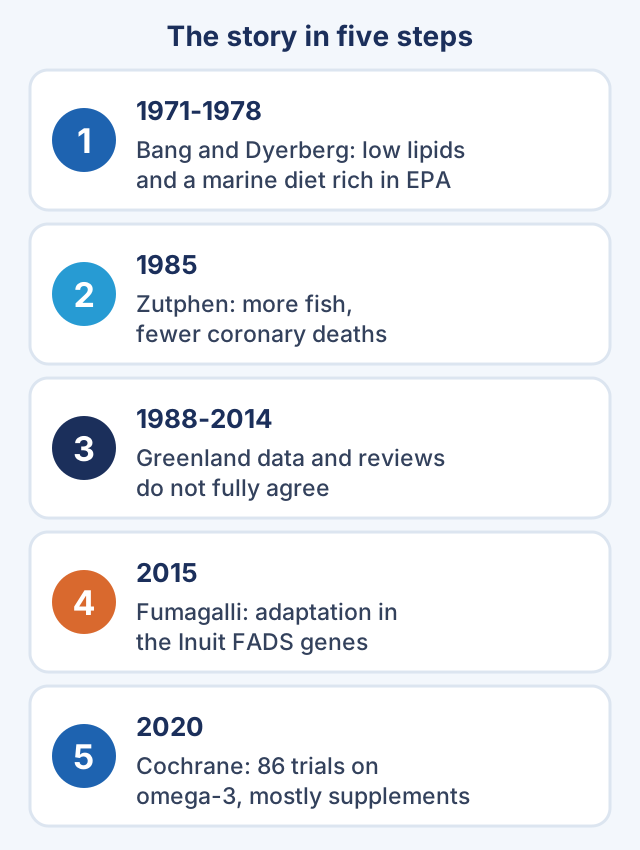
The observation that started it all
In the 1970s two Danish researchers, Bang and Dyerberg, studied the Inuit of Greenland's west coast. In 1971 they published in The Lancet the pattern of lipids and lipoproteins in their plasma, and a later paper summarises that these levels were markedly lower than in Western populations (Dyerberg and colleagues, 1975). They then measured the diet: they collected samples of the food of seven people, hunters and their wives, over seven days. It was a diet of mainly marine origin, with more protein and less carbohydrate than the Danish one, and with more long-chain polyunsaturated fatty acids, especially EPA (Bang and colleagues, 1976).
In 1978 they proposed a mechanism: EPA does not induce platelet aggregation in the laboratory, and the Inuit had plenty of EPA, little arachidonic acid and, according to the authors, a low incidence of myocardial infarction and a tendency to bleed. They raised, as a possibility, that enriching the diet with EPA might protect against thrombosis (Dyerberg and colleagues, 1978). It was a hypothesis, and that is how they presented it.
What was seen afterwards
The story became more complex. Mortality data from Greenland between 1968 and 1983 showed fewer deaths from ischaemic heart disease than in Denmark, especially in the settlements, but more from cerebrovascular disease. The authors suggested that living conditions (among them a high intake of seafood) and a genetic predisposition might protect against ischaemic heart disease and predispose to cerebrovascular disease (Bjerregaard and Dyerberg, 1988). By contrast, a 2014 review concluded that most studies find coronary artery disease in the Inuit of Greenland, Canada and Alaska as often as in other populations, and that the 1970s work had not measured its prevalence (Fodor and colleagues, 2014).
In between, the idea bore fruit of its own. In the Zutphen study (the Netherlands), 852 men without coronary heart disease were followed for 20 years. Coronary mortality was more than 50% lower among those who ate at least 30 g of fish a day than among those who did not eat fish, and the authors concluded that even one or two fish dishes a week might have preventive value (Kromhout and colleagues, 1985). It is an observational study, so it does not prove cause.
What genetics tells us
In 2015, an analysis of Greenlandic Inuit genomes searched for signals of adaptation. The strongest was in the cluster of fatty acid desaturase (FADS) genes, the enzymes that determine the levels of polyunsaturated fatty acids. The selected alleles are associated with several metabolic and bodily traits, with large effects on weight and height, and they modify the fatty acid composition of membranes. The authors conclude that the Inuit have genetic and physiological adaptations to a diet rich in these fatty acids (Fumagalli and colleagues, 2015).
This has a practical reading: the same diet may interact differently with different genomes. It is the same group of genes that we explain in our FADS1 entry, which shows how variants in that region are associated with the conversion of plant omega-3 into EPA.
What the trials say
The remaining question was whether taking long-chain omega-3 improves cardiovascular health. The 2020 Cochrane review brought together 86 randomised trials with 162,796 participants, mostly in high-income countries and with capsule supplements. With high certainty, increasing EPA and DHA has little or no effect on all-cause mortality (RR 0.97; 95% CI 0.93 to 1.01) or on cardiovascular events (RR 0.96; 0.92 to 1.01). With low certainty, it might reduce coronary events (RR 0.91; 0.85 to 0.97) and coronary mortality (RR 0.90; 0.81 to 1.00). And, with high certainty, it reduces triglycerides, by about 15% and depending on the dose (Abdelhamid and colleagues, 2020).
There is one important nuance: the authors point out that there is little evidence on the effects of eating fish, and most trials assess supplements. That is why the Zutphen observation and the supplement trials do not contradict each other: they measure different things.
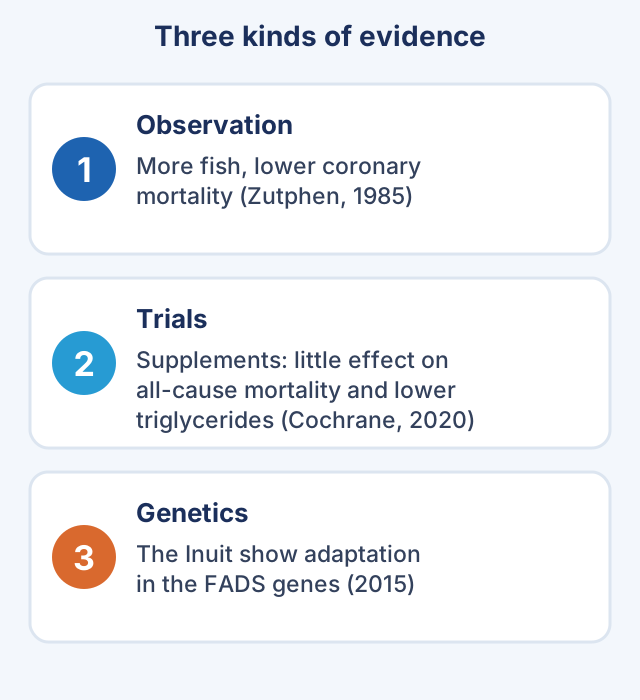
Genotype and diet: what the evidence says
The table summarises what has been observed in each kind of study, at population level and not in your own case. In the last row, the label is the CESGEN Dictionary label for variants; in the other two, the type of study is given:
| What was studied | What has been observed | What you can do | Evidence |
|---|---|---|---|
| Eating fish regularly | Coronary mortality more than 50% lower with at least 30 g of fish a day than with none, in 852 men followed for 20 years (Kromhout and colleagues, 1985). | Include fish regularly: the authors themselves speak of one or two dishes a week. | Observational association (cohort study) |
| Long-chain omega-3 as supplements | Little or no effect on all-cause mortality and cardiovascular events; a possible reduction in coronary events and lower triglycerides (Abdelhamid and colleagues, 2020). | If you are considering a supplement, discuss it with your health professional in line with the recommendations that apply to your situation. | Systematic review of trials (high to low certainty, depending on the result) |
| Variants in the FADS genes | The strongest selection signal in the Inuit (Fumagalli and colleagues, 2015); in European populations, the variant rs174537 is associated with fatty acid levels (our FADS1 entry); this does not validate that the Inuit adaptation lies in rs174537. | The advice does not change by genotype: direct sources of EPA and DHA. | Replicated association, uncertain clinical utility |
Why is there no different recommendation by genotype? Because none of the studies cited has checked that adjusting omega-3 intake according to genes improves a health outcome. What the Inuit teach is that genetics matters, not yet that it should change what you eat.
If you have a genetic file
The Inuit adaptation affects the same group of genes (FADS) as the variant rs174537 in our FADS1 entry. If you have a 23andMe or AncestryDNA file, you will find there how to look it up and a table with what has been observed for each genotype. A single variant does not tell the whole story, and it does not tell you whether your genome carries an adaptation like the Inuit one. This information describes what has been observed in studies and does not replace an assessment by a health professional.
What to bear in mind
- The Inuit diet was not just fish. The 1970s work describes a diet of mainly marine origin, including marine mammals, and a small sample (seven people) to measure it (Bang and colleagues, 1976).
- The health data do not fully agree. Mortality from ischaemic heart disease was lower in Greenland (Bjerregaard and Dyerberg, 1988), but a later review finds coronary artery disease as often in most studies (Fodor and colleagues, 2014).
- Most trials in the Cochrane review assess supplements, in adults at varying cardiovascular risk and in high-income countries.
What you can do with this information
- Include fish regularly. An observational study with 20 years of follow-up supports it, and the authors themselves speak of one or two dishes a week.
- If you are thinking of an omega-3 supplement, discuss it with your professional: trials show little effect on all-cause mortality and cardiovascular events, and a drop in triglycerides.
- Understand your own response. Your genes may change how you convert plant omega-3; direct sources, such as fish, remain a route that does not depend on that conversion.
That is how the Inuit story improves eating: it does not tell you which supplement to take, but it explains why fish stays on the plate and why science keeps refining the advice.
Sources
- Plasma lipid and lipoprotein pattern in Greenlandic West-coast Eskimos, Bang HO, Dyerberg J, Nielsen AB. The Lancet 1:1143-1145 (PMID 4102857), 1971
- Fatty acid composition of the plasma lipids in Greenland Eskimos, Dyerberg J, Bang HO, Hjorne N. American Journal of Clinical Nutrition 28:958-966 (PMID 1163480), 1975
- The composition of food consumed by Greenland Eskimos, Bang HO, Dyerberg J, Hjøorne N. Acta Medica Scandinavica 200:69-73 (PMID 961471), 1976
- Eicosapentaenoic acid and prevention of thrombosis and atherosclerosis?, Dyerberg J, Bang HO, Stoffersen E, Moncada S, Vane JR. The Lancet 2:117-119 (PMID 78322), 1978
- The inverse relation between fish consumption and 20-year mortality from coronary heart disease, Kromhout D, Bosschieter EB, de Lezenne Coulander C. New England Journal of Medicine 312:1205-1209 (PMID 3990713), 1985
- Mortality from ischaemic heart disease and cerebrovascular disease in Greenland, Bjerregaard P, Dyerberg J. International Journal of Epidemiology 17:514-519 (PMID 3209329), 1988
- "Fishing" for the origins of the "Eskimos and heart disease" story: facts or wishful thinking? (review), Fodor JG, Helis E, Yazdekhasti N, Vohnout B. Canadian Journal of Cardiology 30:864-868 (PMID 25064579), 2014
- Greenlandic Inuit show genetic signatures of diet and climate adaptation, Fumagalli M et al. Science 349:1343-1347 (PMID 26383953), 2015
- Omega-3 fatty acids for the primary and secondary prevention of cardiovascular disease (Cochrane systematic review), Abdelhamid AS et al. Cochrane Database of Systematic Reviews 3:CD003177 (PMID 32114706), 2020
Educational content from CESGEN, based on the evidence published up to the review date. It does not replace individual medical or dietary advice: to apply it to your own case, talk it through with your health professional. Nutrigenetics is an evolving field, and we review each piece when the evidence changes.