Fish or algae? Your genes and your omega-3
Your body makes some EPA from plant omega-3, and FADS1/FADS2 variants shape how much. Oily fish and algal oil supply ready-made EPA and DHA.
The omega-3 fatty acids EPA and DHA are the ones we associate with oily fish, and your body does not only receive them from food: it also makes some of them from plant omega-3. How efficient that factory is varies from person to person, and one of the reasons is the FADS1 gene. Understanding how it works helps with something very practical: knowing which sources of EPA and DHA are worth keeping in your diet, whether or not you eat fish.
One letter, one change
The FADS1 gene sits on chromosome 11, right next to its neighbour FADS2. Both make enzymes called desaturases, which set the pace of the conversion of fatty acids (Ameur and colleagues, 2012). The most studied variant, rs174537, lies close to FADS1.
There is an important nuance: rs174537 does not act alone. Ameur and colleagues genotyped 5,652 people from five European cohorts and sequenced the region in another 960. They found that two common haplotypes coexist in the population today, defined by 28 tightly linked variants across 38.9 kb, and that rare variants added no independent effects. rs174537 is one of the most studied variants in this region, but the studies cited do not show that it identifies one of the two haplotypes on its own.
What the desaturases do
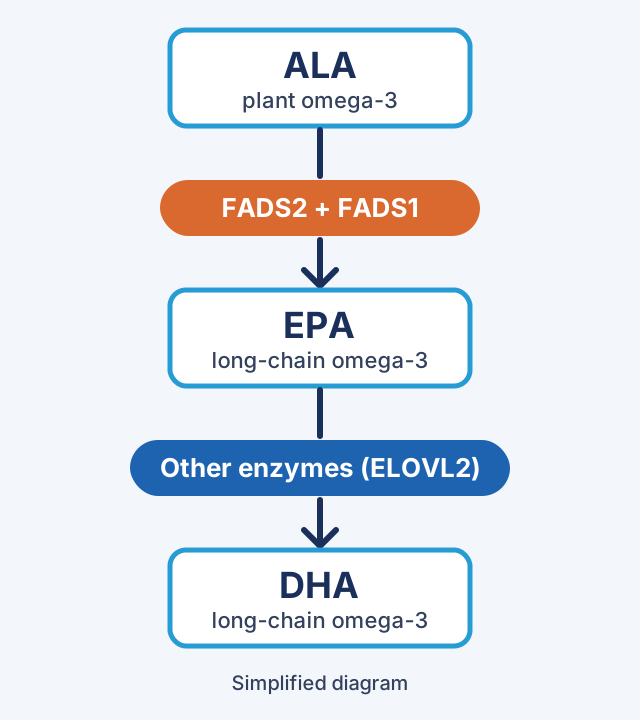
Plant omega-3, such as the alpha-linolenic acid (ALA) in linseed oil, is the starting point. To reach the long-chain forms (EPA, DPA and DHA), the body lengthens and modifies it in several steps. FADS2 and FADS1 code for desaturases that limit this conversion (Ameur and colleagues, 2012); ELOVL2 codes for an elongase that is also associated with omega-3 levels (Lemaitre and colleagues, 2011). The same system also makes arachidonic acid, an omega-6.
It is a pathway that works, but with limits. According to the reviews by Burdge and Calder (2005) and Brenna and colleagues (2009), increasing dietary ALA can raise blood EPA but usually has little effect on DHA, whereas ready-made DHA does raise it. This conversion is higher in women than in men. That is why diets that include oily fish are a direct route to EPA and DHA, while plant-based diets are a source of ALA that the body converts in part.
The mechanism, step by step
1. The locus has two common versions. Ameur and colleagues describe a more efficient haplotype, evolutionarily derived, and a less efficient one. The two versions differ markedly in their capacity to produce long-chain fatty acids.
2. The version determines desaturase activity. In 310 healthy volunteers, Al-Hilal and colleagues (2013) saw that the genotype at rs174537 and two other variants was associated with the activity of both desaturases: carrying the less common allele went with lower FADS1 and FADS2 activity, with more substrate and less product in the blood. Mathias and colleagues (2011) associated the G allele of rs174537 with a greater conversion of DGLA into arachidonic acid, with a similar effect in African Americans and European Americans.
3. It shows in blood fatty acid levels. In the InCHIANTI study (1,075 people), rs174537 was the variant most strongly associated with arachidonic acid, an association confirmed in a separate cohort of 1,076 people (Tanaka and colleagues, 2009). It explained 18.6% of the additive variation in that acid. For omega-3, a meta-analysis of 8,866 people of European ancestry found that the less common alleles of FADS1 and FADS2 were associated with more ALA and less EPA and DPA in plasma (Lemaitre and colleagues, 2011), which points to lower conversion.
4. Diet also moves the activity. In a six-month randomised trial, increasing EPA and DHA intake raised FADS1 activity and lowered FADS2 activity, and the rs174537 genotype modulated part of that response (Al-Hilal and colleagues, 2013; the interaction was borderline for statistical significance, P = 0.05).
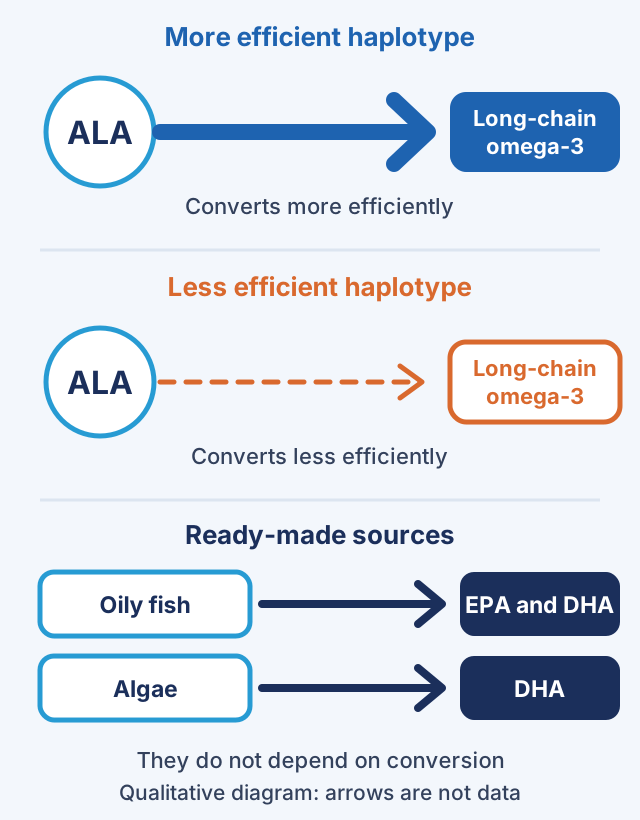
How sure are we? The association between the FADS1/FADS2 locus and blood fatty acid levels is very solid: it has been repeated in European cohorts and in other ancestries. The response of the genotype to diet has less support, and differences between people depend on many other factors.
Genotype and diet: what the evidence says
The practical question is whether your genotype changes what is best for you to eat. What has been published allows an answer with some nuance. The table describes what has been observed in studies, in populations, and not anyone's individual case; the letters are those of the forward strand of the reference genome:
| Your genotype | What has been observed | What you can do | Evidence |
|---|---|---|---|
| GG | This is the genotype associated with higher desaturase efficiency and higher arachidonic acid levels (Tanaka and colleagues, 2009; Mathias and colleagues, 2011). | Include direct sources of EPA and DHA: oily fish regularly or, if you do not eat fish, algal DHA. | Replicated association, uncertain clinical utility |
| GT | The summaries of the studies consulted give no specific result for this genotype: they mainly describe the two extremes. | The same approach as for GG. | Replicated association, uncertain clinical utility |
| TT | Less arachidonic acid and less EPA in blood than in GG (Tanaka and colleagues, 2009) and, in carriers of the less common allele, lower estimated desaturase activity (Al-Hilal and colleagues, 2013). | The same approach as for GG. | Replicated association, uncertain clinical utility |
Why is the approach the same for all three genotypes? Because what the studies show is a relationship between genotype and fatty acid levels or enzyme activity, and the studies cited have not shown a clinical benefit from adjusting intake by this genotype. The randomised trial by Al-Hilal and colleagues (2013), with 310 volunteers, saw that the rs174537 genotype modulated part of the FADS1 response to diet, but with a borderline result (P = 0.05). That is why the advice is not refined by genotype: having direct sources of EPA and DHA is a good idea for everyone. That people with TT may depend more on them, because they convert less from plant omega-3, is a reasonable hypothesis, but for now an exploratory one that is not actionable.
If you have a genetic file
If your file is from 23andMe or AncestryDNA, look for rs174537 (the steps are in the genetic file guide). This entry uses the letters of the forward strand of the reference genome (the dbSNP one); check the header or the documentation of your file to see which strand it uses before applying the table. If your file uses the reverse strand, each letter is replaced by its complement (G↔C, A↔T).
| What you will see in your file | What this entry calls it | What has been observed |
|---|---|---|
| GG | GG genotype | Higher desaturase efficiency and more arachidonic acid |
| GT or TG | GT genotype | No specific result in the studies consulted |
| TT | TT genotype | Less arachidonic acid and less EPA; lower estimated desaturase activity |
Three points to bear in mind. The chip used for your file may not include this variant; if you cannot find it, it was not measured. If it appears with dashes or zeros instead of letters, check how your file marks positions that were not read. And rs174537 is one of many linked variants in a region, so a single letter does not tell the whole story. This table describes what has been observed in studies and does not replace an assessment by a health professional.
A variation with a history
The two versions of the locus have a documented evolutionary history. Ameur and colleagues found that the more efficient haplotype appeared after the split between the lineages of modern humans and Neanderthals, and shows signs of positive selection: it may have given an advantage in environments with little dietary access to long-chain fatty acids. In Africa, the high-efficiency variants appear to have been taken almost to fixation by positive selection about 85,000 years ago (Mathias and colleagues, 2012). In Europe, Ye and colleagues (2017) showed that selection acted on the same variants before and after the arrival of agriculture, but on alternative alleles, in line with changes in diet. These are reasonable hypotheses about the why, not a demonstrated mechanism.
What to bear in mind when applying it
- The genotype speaks of conversion, not of what you need. What has been measured are fatty acid levels and proportions in blood and the estimated activity of the enzymes; there is no figure that says how much EPA or DHA suits each person.
- The "less common" allele depends on the population. Among African Americans, the GG genotype is much more common (79% to 82%) than among European Americans (42% to 45%), and the effect of the G allele on enzyme efficiency was similar in both groups (Mathias and colleagues, 2011). A useful reading of the result takes ancestry into account.
- It is not a verdict on any diet. Lower EPA and DHA levels have been observed in vegetarian women than in omnivores (Burdge and colleagues, 2017); direct sources of DHA can help improve their blood levels, as explained below.
What you can do with this information
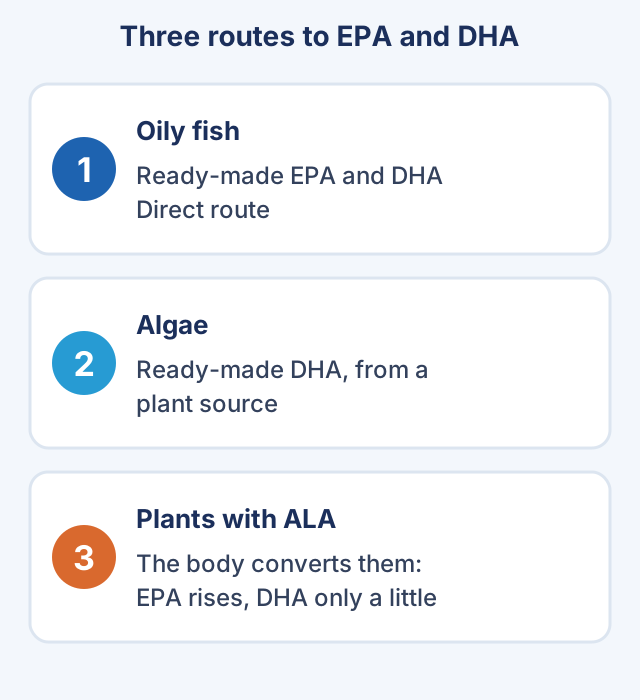
- Oily fish regularly. Oily fish is the main dietary source of EPA and DHA (Burdge and colleagues, 2017). It is a direct route that does not depend on how efficient your internal factory is.
- If you do not eat fish, there is a plant-based alternative. Algal oil is a source of ready-made DHA. In 32 healthy adults, the DHA from algal-oil capsules reached plasma and red blood cells equivalently to that from cooked salmon (Arterburn and colleagues, 2008). A systematic review found that algal DHA improves DHA concentrations in vegetarian populations (Craddock and colleagues, 2017). If you are considering a supplement, discuss it with your health professional in line with the nutritional recommendations that apply to your situation; rs174537 on its own does not indicate supplementation.
- Plant omega-3 still counts. Increasing ALA, for example with linseed oil, can raise blood EPA, although it usually has little effect on DHA; it can complement the direct sources.
- Ask for interpretation in context. If you have your genotype, read it alongside your ancestry and your diet, and with your professional: that way it becomes a useful clue and not a label.
This is how genetic information improves nutrition: it does not tell you what to eat, but it helps you make sure that direct sources of EPA and DHA are on your plate.
Sources
- Genetic adaptation of fatty-acid metabolism: a human-specific haplotype increasing the biosynthesis of long-chain omega-3 and omega-6 fatty acids, Ameur A et al. American Journal of Human Genetics 90:809-820 (PMID 22503634), 2012
- Genome-wide association study of plasma polyunsaturated fatty acids in the InCHIANTI Study, Tanaka T et al. PLoS Genetics 5:e1000338 (PMID 19148276), 2009
- Genetic loci associated with plasma phospholipid n-3 fatty acids: a meta-analysis of genome-wide association studies from the CHARGE Consortium, Lemaitre RN et al. PLoS Genetics 7:e1002193 (PMID 21829377), 2011
- Genetic variation at the FADS1-FADS2 gene locus influences delta-5 desaturase activity and LC-PUFA proportions after fish oil supplement, Al-Hilal M et al. Journal of Lipid Research 54:542-551 (PMID 23160180), 2013
- The impact of FADS genetic variants on ω6 polyunsaturated fatty acid metabolism in African Americans, Mathias RA et al. BMC Genetics 12:50 (PMID 21599946), 2011
- Adaptive evolution of the FADS gene cluster within Africa, Mathias RA et al. PLoS One 7:e44926 (PMID 23028684), 2012
- Dietary adaptation of FADS genes in Europe varied across time and geography, Ye K et al. Nature Ecology & Evolution 1:167 (PMID 29094686), 2017
- Conversion of alpha-linolenic acid to longer-chain polyunsaturated fatty acids in human adults (review), Burdge GC, Calder PC. Reproduction Nutrition Development 45:581-597 (PMID 16188209), 2005
- alpha-Linolenic acid supplementation and conversion to n-3 long-chain polyunsaturated fatty acids in humans (review), Brenna JT et al. Prostaglandins, Leukotrienes and Essential Fatty Acids 80:85-91 (PMID 19269799), 2009
- Long-chain n-3 PUFA in vegetarian women: a metabolic perspective (review), Burdge GC, Tan SY, Henry CJ. Journal of Nutritional Science 6:e58 (PMID 29209497), 2017
- Algal-oil capsules and cooked salmon: nutritionally equivalent sources of docosahexaenoic acid, Arterburn LM et al. Journal of the American Dietetic Association 108:1204-1209 (PMID 18589030), 2008
- Algal supplementation of vegetarian eating patterns improves plasma and serum docosahexaenoic acid concentrations and omega-3 indices: a systematic literature review, Craddock JC et al. Journal of Human Nutrition and Dietetics 30:693-699 (PMID 28417511), 2017
- dbSNP, rs174537: alleles (forward strand of the reference genome) and 1000 Genomes Project frequencies, NCBI dbSNP, accessed 6 November 2026, 2026
Educational content from CESGEN, based on the evidence published up to the review date. It does not replace individual medical or dietary advice: to apply it to your own case, talk it through with your health professional. Nutrigenetics is an evolving field, and we review each piece when the evidence changes.