Hunger before birth: the mark it leaves on DNA
Conceived in the 1944 Dutch famine, 60 years later they had less methylation of the IGF2 gene. What epigenetics teaches and where your PPARG gene fits in.
In the winter of 1944-45, the Netherlands went through a famine, the ‘Hunger Winter’, with official rations averaging about 667 kilocalories a day. Sixty years later, people conceived during those months had less DNA methylation in the IGF2 gene than their same-sex siblings conceived at another time (Heijmans and colleagues, 2008). It is one of the most cited pieces of evidence for what epigenetics studies: what happens to nutrition at the very start of life can leave chemical marks on DNA that last for decades. And another study of people exposed to the famine found something that matters to nutrigenomics: the effect of the PPARG gene on glucose depended on whether the person had gone hungry before birth (de Rooij and colleagues, 2006). The practical message is concrete: nutrition during pregnancy is the foundation for every woman; and in adult life, with your PPARG genotype you can try giving more weight to one type of fat or another, as something to try and observe, on top of the habits that apply to everyone.
The Hunger Winter
Official rations were set weekly and were the same for everyone: 667 kilocalories a day on average, with around 12% of calories from protein, 19% from fat and 69% from carbohydrate (Heijmans and colleagues, 2008). Because the famine began and ended on known dates, it is possible to tell at what stage of pregnancy each person born around those months was exposed to it, which is unusual in a nutrition study.
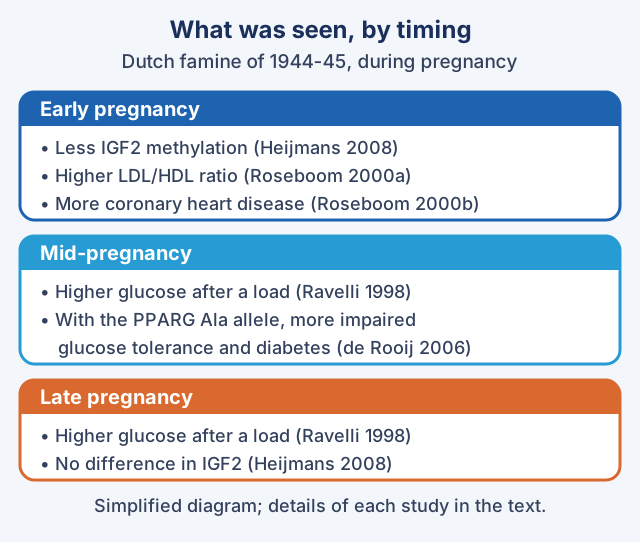
The researchers of the Dutch famine birth cohort, made up of people born in an Amsterdam hospital around that time, have followed them for more than 25 years. In their summary of that work, they conclude that the effect depended on the stage of pregnancy at which the famine was experienced and on the organs developing at the time, and that early gestation was the most vulnerable period (de Rooij and colleagues, 2022). In their original studies, people exposed in early pregnancy had, at age 50, an LDL to HDL cholesterol ratio 13.9% higher than those not exposed (Roseboom and colleagues, 2000a) and more coronary heart disease, 8.8% versus 3.2%, although the authors warn that the numbers are very small (Roseboom and colleagues, 2000b). In a later follow-up, people conceived during the famine developed coronary heart disease three years earlier, at an average age of 47 versus 50 (Painter and colleagues, 2006). Blood glucose two hours after a glucose drink was higher in people exposed at any stage of pregnancy, especially in mid and late gestation (Ravelli and colleagues, 1998).
The mark on the IGF2 gene
The IGF2 gene makes insulin-like growth factor 2, and it is an imprinted gene: its activity depends on methylation marks that distinguish the copy inherited from each parent. A team from Leiden University and Columbia University compared methylation of a regulatory region of IGF2 in 60 people conceived during the famine with that of a same-sex brother or sister who had not been exposed, which partly matches their genetics. Average methylation was 0.488 in the exposed people and 0.515 in their siblings, 5.2% lower, and it was lower in the exposed person in 72% of the pairs (43 of 60) (Heijmans and colleagues, 2008).
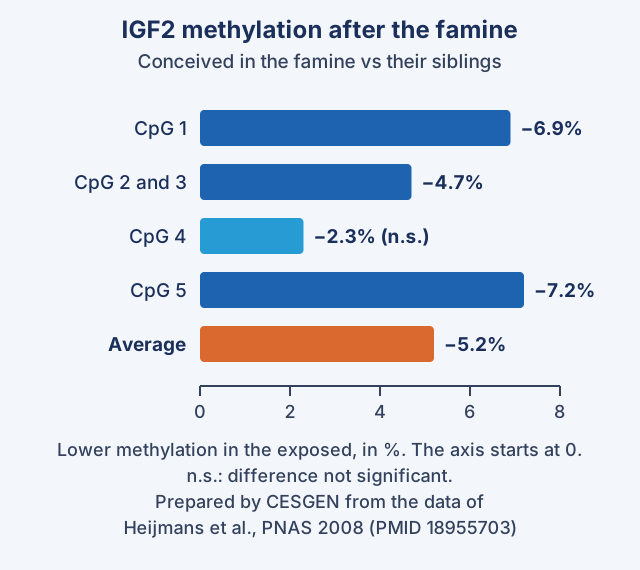
Timing was decisive. In another 62 people who were exposed to the famine late in pregnancy, for at least ten weeks, there was no difference from their siblings (Heijmans and colleagues, 2008). The authors suggest that a lack of methyl-group donors, such as the amino acid methionine, may have contributed, and they warn that other factors of that winter, such as cold or stress, cannot be ruled out (Heijmans and colleagues, 2008).
One letter, one change: PPARG
The PPARG gene makes the PPARγ receptor, and its PPARγ2 form acts mainly in fat tissue, where it regulates genes of fat and glucose metabolism; dietary fatty acids are probably among its natural activators (Luan and colleagues, 2001). Its most studied variant is rs1801282: in the gene, a C changes to a G, and at position 12 of the protein an alanine replaces the proline (Pro12Ala). The proline allele is the more common one: 85% of alleles in the study by Altshuler and colleagues (2000). In one population study, 79.1% of people were Pro/Pro and 2.0% were Ala/Ala (Luan and colleagues, 2001).
A gene that changes with each person's history
In the general population, the proline allele, the more common one, was associated with a 1.25-fold increase in the risk of type 2 diabetes. Of 16 published genetic associations with diabetes at the time, it was the only one that team was able to confirm across several samples, with more than 3,000 people analysed (Altshuler and colleagues, 2000). Seen that way, alanine looks like the favourable variant.
The famine studies show that the story is more interesting. In 675 people born in Amsterdam around the time of the famine, from the birth cohort described above and not from the IGF2 sibling study, the alanine allele was associated with more impaired glucose tolerance and more type 2 diabetes, but only in those who had been exposed to famine in mid-pregnancy; in the rest, it was not (de Rooij and colleagues, 2006). The authors suggest that this may be due to two combined shortfalls in insulin secretion: that of a pancreas that developed with little food, and that contributed by the alanine. No study has linked IGF2 methylation to this effect of PPARG.
Adult diet also changes the outcome. In 592 adults without diabetes from a population study, when the diet had little polyunsaturated fat relative to saturated fat, carriers of the alanine allele (analysed together, Pro/Ala and Ala/Ala, because only 2.0% were Ala/Ala) had a higher body mass index than Pro/Pro people; when that ratio was high, the opposite was seen (Luan and colleagues, 2001). And in the Finnish Diabetes Prevention Study, with 522 people with impaired glucose tolerance, the alanine allele was associated with more diabetes after three years; but in the group that received the intensive diet and exercise programme, Ala/Ala people lost more weight than those with other genotypes and none of them developed diabetes (Lindi and colleagues, 2002). This is an observation in a small subgroup that would need confirming.
The same letter, then, has no fixed effect: it depends on what was eaten before birth and on what is eaten afterwards. That is the central idea of nutrigenomics, and in the post on how a gene test decides your diet we explain how PPARG has been used in commercial tests.
Genotype and diet: what the evidence says
The table summarises results from groups of people and does not necessarily predict your own case. Genotypes are named as in the papers (Pro/Pro, Pro/Ala, Ala/Ala) and, in brackets, as you will see them in a genetic file.
| Your PPARG genotype (rs1801282) | What has been observed | What you can do |
|---|---|---|
| Pro/Pro (CC in the file) | In the general population, each proline allele was associated with a 1.25-fold increase in the risk of type 2 diabetes (Altshuler and colleagues, 2000); the figure applies to the allele, not an estimate for each CC person. | You carry two copies of the more common allele: make the usual levers your priority, keeping a healthy weight, moving every day and choosing mainly unsaturated fats. If you have a family history of diabetes, ask your health professional whether your glucose should be checked at your routine appointments. |
| Pro/Ala (CG or GC) | In carriers of the alanine allele, analysed together, body mass index was higher than in Pro/Pro with little polyunsaturated fat relative to saturated fat, and lower with a lot (Luan and colleagues, 2001). In people with impaired glucose tolerance, the alanine allele was associated with more diabetes after three years (Lindi and colleagues, 2002). | As something to try and observe, give more weight to polyunsaturated fats (walnuts, sunflower seeds, oily fish such as sardines) than to saturated fats (butter, pastries, fatty minced meat): in carriers of your allele, that ratio was linked to a lower weight. If you have been told your glucose is high, mention it to your health professional: in the Finnish trial, changes in diet and physical activity appeared to partly offset the effect of the alanine. |
| Ala/Ala (GG) | The fat study analysed all carriers of the alanine allele together, and the effect in Ala/Ala on its own is not known (Luan and colleagues, 2001). In the intensive diet and exercise programme of the Finnish trial, the Ala/Ala subgroup lost more weight than the other genotypes and none of them developed diabetes after three years (Lindi and colleagues, 2002). | As something to try and observe, also give more weight to polyunsaturated than to saturated fats, as for Pro/Ala. And if you are planning to change your habits, that subgroup's result is a good reason to start, although it cannot tell you how much it will help you personally. |
On the levels of evidence: keeping a healthy weight, being active and choosing unsaturated fats are general population recommendations and the base of all three rows. That the proline allele is associated with more diabetes risk has been replicated in several samples (‘Replicated association, uncertain clinical utility’). The interaction with the fat ratio comes from a single population study that grouped carriers of the alanine allele, and the greater response of Ala/Ala to the diet and exercise programme from a small subgroup of one trial (‘Exploratory, not actionable’): that is why those recommendations are framed as something to try and observe, without promising that your genotype predicts how much a change in diet will help you. The interaction with the famine (de Rooij and colleagues, 2006) has been seen in a single cohort and applies only to people who went hungry before birth.
If you have a genetic file
If your file is from 23andMe or AncestryDNA, look for rs1801282 (the steps are in the genetic file guide). In the 23andMe files we checked for another post, versions v3, v4 and v5, this variant is present; we have not checked AncestryDNA. PPARG is read on the forward strand of the reference genome, so the letters in the file match those in the papers: C is proline and G is alanine. Even so, check the header or documentation of your file to see which strand it uses.
| What you will see in your file | What this post calls it | What has been observed |
|---|---|---|
| rs1801282: CC | Pro/Pro | Two copies of the allele associated with slightly higher type 2 diabetes risk in the general population |
| rs1801282: CG or GC | Pro/Ala | In carriers of the alanine allele, higher or lower weight depending on the ratio of polyunsaturated to saturated fat |
| rs1801282: GG | Ala/Ala | No separate data on fats; more weight loss in a subgroup of a diet and exercise trial |
| Any other combination, or dashes or zeros | Cannot be determined from this file | Check the strand and format before interpreting |
Your file's chip may not include this variant. This table describes what has been observed in studies and does not replace an assessment by a health professional.
What to bear in mind when applying it
A famine is not a diet. The people in these studies lived through an extreme situation. Their results show why nutrition at the start of life matters, not that a particular adult diet leaves similar marks.
IGF2 methylation is an association. The study by Heijmans and colleagues compares siblings, which is a great strength, but it does not show that this difference in methylation causes the diseases that later appeared in the cohort. Nor is there an IGF2 methylation test today that can be used to decide what to eat.
The effect of PPARG changes with context. The same variant is associated with less diabetes in the general population and with more in people with impaired glucose tolerance or who went hungry before birth (Altshuler and colleagues, 2000; Lindi and colleagues, 2002; de Rooij and colleagues, 2006). That is why the genotype guides rather than decides, and it is best interpreted together with your test results and your history.
This post does not recommend supplements based on a variant. What is suggested by genotype are changes in the type of fat and in habits. During pregnancy, advice on diet and supplements comes from your health professional, whatever your genotype.
What you can do with this information
Look after nutrition from the very start. The cohort researchers conclude that the mother's nutrition during pregnancy, especially early on, is the foundation of future health (de Rooij and colleagues, 2022). If you are planning a pregnancy, now is the best time to talk it over with your health professional.
Use your genotype as a clue when choosing fats. With Pro/Pro, the usual levers (weight, activity and unsaturated fats) are your priority. With Pro/Ala or Ala/Ala, as something to try and observe, give more weight to polyunsaturated than to saturated fats. According to the USDA tables, per 100 g, walnuts provide 47.2 g of polyunsaturated fat versus 6.13 g of saturated fat; sunflower seeds, 23.1 g versus 4.46 g; and sardines canned in oil, 5.15 g versus 1.53 g. By contrast, butter provides 51.4 g of saturated fat versus 3.04 g of polyunsaturated fat; croissants, 11.7 g versus 1.09 g; and minced beef with 20% fat, 7.58 g versus 0.52 g.
If your glucose is high, do not leave it. In the Finnish trial, the diet and exercise programme appeared to partly offset the effect of the allele that carried more risk in those people: discuss your genotype and your test results with your health professional.
The Dutch famine teaches it in a harsh but clear way: genes do not act alone, and what is eaten, before and after birth, changes what they do. Your genotype does not decide for you, but it tells you where your effort is most worthwhile.
Sources
- Persistent epigenetic differences associated with prenatal exposure to famine in humans, Heijmans BT et al. Proceedings of the National Academy of Sciences 105:17046-17049 (PMID 18955703), 2008
- Plasma lipid profiles in adults after prenatal exposure to the Dutch famine, Roseboom TJ et al. (2000a). American Journal of Clinical Nutrition 72:1101-1106 (PMID 11063435), 2000
- Coronary heart disease after prenatal exposure to the Dutch famine, 1944-45, Roseboom TJ et al. (2000b). Heart 84:595-598 (PMID 11083734), 2000
- Early onset of coronary artery disease after prenatal exposure to the Dutch famine, Painter RC et al. American Journal of Clinical Nutrition 84:322-327 (PMID 16895878), 2006
- Glucose tolerance in adults after prenatal exposure to famine, Ravelli AC et al. Lancet 351:173-177 (PMID 9449872), 1998
- Lessons learned from 25 years of research into long term consequences of prenatal exposure to the Dutch famine 1944-45: the Dutch famine Birth Cohort, de Rooij SR et al. International Journal of Environmental Health Research 32:1432-1446 (PMID 33949901), 2022
- The effects of the Pro12Ala polymorphism of the peroxisome proliferator-activated receptor-gamma2 gene on glucose/insulin metabolism interact with prenatal exposure to famine, de Rooij SR et al. Diabetes Care 29:1052-1057 (PMID 16644636), 2006
- The common PPARgamma Pro12Ala polymorphism is associated with decreased risk of type 2 diabetes, Altshuler D et al. Nature Genetics 26:76-80 (PMID 10973253), 2000
- Evidence for gene-nutrient interaction at the PPARgamma locus, Luan J et al. Diabetes 50:686-689 (PMID 11246892), 2001
- Association of the Pro12Ala polymorphism in the PPAR-gamma2 gene with 3-year incidence of type 2 diabetes and body weight change in the Finnish Diabetes Prevention Study, Lindi VI et al. Diabetes 51:2581-2586 (PMID 12145174), 2002
- dbSNP: rs1801282 (forward-strand alleles and amino acid change), NCBI, National Library of Medicine; checked for the post on how a gene test decides your diet, 09/11/2026, 2026
- USDA FoodData Central, SR Legacy: saturated and polyunsaturated fatty acids in walnuts (FDC 170187), sunflower seeds (170562), sardines canned in oil (175139), butter (173410), croissants (174987) and 20%-fat minced beef (174036), US Department of Agriculture, accessed 16/11/2026, 2019
Educational content from CESGEN, based on the evidence published up to the review date. It does not replace individual medical or dietary advice: to apply it to your own case, talk it through with your health professional. Nutrigenetics is an evolving field, and we review each piece when the evidence changes.