Why does coffee affect people so differently?
Two genes, CYP1A2 and ADORA2A, help explain why caffeine performs, feels and is tolerated so differently. What the evidence says on sport, health and sleep.
Two people drink the same coffee: one sleeps like a baby and the other lies awake; for one cyclist caffeine shaves off minutes, for another it changes nothing, or makes things worse. Part of that difference lies in two genes, CYP1A2 and ADORA2A, and their variants have been studied in people, with results that are good for something concrete: how much you gain from caffeine in sport, how much attention to pay to your blood pressure if you drink a lot of coffee, and who gets more jittery or sleeps worse. Your genotype tells you where to fine-tune. And there is good general news: in almost half a million people, drinking coffee was associated with lower mortality, whatever the genetic profile of caffeine metabolism (Loftfield and colleagues, 2018).
One letter, one change
The CYP1A2 gene, on chromosome 15, makes the liver enzyme that metabolises caffeine. The best-studied variant is rs762551: a C becomes an A (the classical literature calls it −163C>A, and Sachse and colleagues described it in 1999 in the first intron of the gene). It does not change the protein, but it is associated with the activity of the enzyme. The A allele is the more common one: it appears in 68% of European chromosomes, 67% of East Asian ones and 56% of African ones (1000 Genomes Project). In the classical studies, 46% of people were AA, 44% AC and 10% CC (Sachse and colleagues, 1999), and AA people were called ‘rapid’ metabolisers and carriers of a C ‘slow’ ones: these are group-average labels, with overlap between people.
The ADORA2A gene, on chromosome 22, makes the adenosine A2A receptor, where caffeine acts. Its best-studied variant is rs5751876: a T becomes a C, with no change of amino acid (papers call it c.1083T>C or 1976C>T). The T allele appears in 39% of European chromosomes. Both genes are on the forward strand of the reference genome, so the dbSNP letters and the gene's letters are the same.
The mechanism, step by step
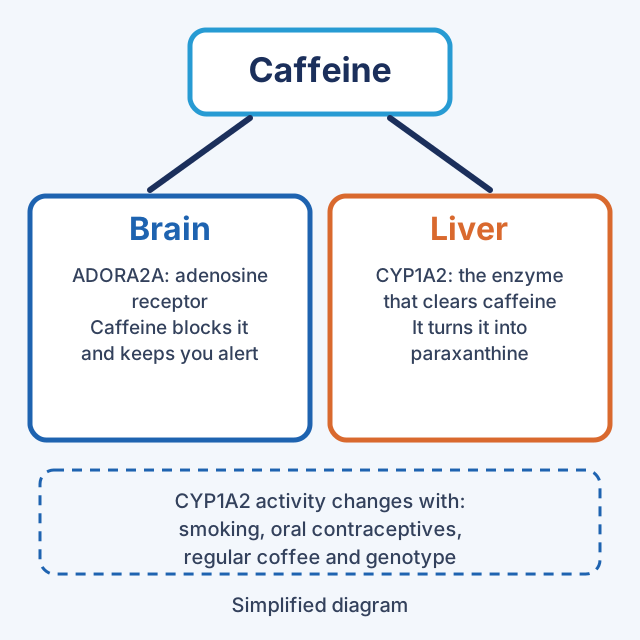
1. In the brain, caffeine blocks adenosine receptors. One of them is the A2A receptor, encoded by ADORA2A, and that blockade underlies its effects on mood and alertness (Alsene and colleagues, 2003); in mice, the sleep disruption caused by caffeine depends on that receptor (Rétey and colleagues, 2007).
2. In the liver, CYP1A2 clears it. The CYP1A2 enzyme metabolises caffeine, and the ratio of paraxanthine (one of its metabolites) to caffeine in blood measures its activity (Dobrinas and colleagues, 2011). Two of the genes that regulate this system, AHR and CYP1A2, appear as determinants of habitual caffeine consumption (Cornelis and colleagues, 2011).
3. The enzyme's activity changes with your life. In 194 smokers, smoking multiplied CYP1A2 activity by 1.55 compared with non-smokers, and oral contraceptives also change it (Dobrinas and colleagues, 2011). Drinking three or more coffees a day increases it (Djordjevic and colleagues, 2008).
4. Genotype adds to this. In 51 smokers, the paraxanthine to caffeine ratio was 1.37 in AA, 0.88 in AC and 0.82 in CC (Sachse and colleagues, 1999); in 185 non-smokers, measured in urine, no differences were seen. In 194 smokers, genotype was associated with enzyme activity; the association persisted in the 118 assessed after they stopped smoking (Dobrinas and colleagues, 2011). What these studies show is an association with measured activity, not with how fast one particular person clears caffeine.
How sure are we? That CYP1A2 metabolises caffeine and that smoking speeds the enzyme up is very well established. That rs762551 is associated with its activity has been seen in several studies, more clearly in smokers. And that ADORA2A takes part in the response to caffeine has been seen in independent studies of anxiety and sleep, as shown below.
Genotype and diet: what the evidence says
The practical question is whether your genotype changes what is best for you to do with coffee. What has been published allows an answer on three fronts: sport, health and sleep. The tables describe what has been observed in studies, in groups of people, and not anyone's individual case; the letters are those of the forward strand of the reference genome.
Sport: rs762551 and the effect of caffeine
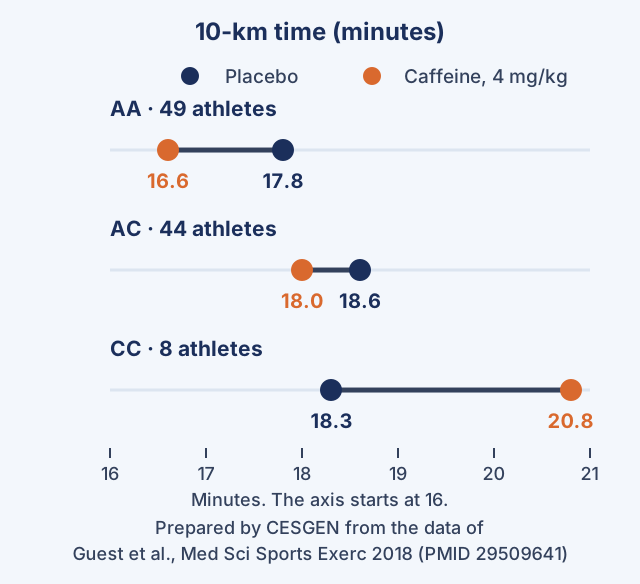
Guest and colleagues (2018) studied 101 male athletes in a 10-km time trial, with 0, 2 or 4 mg of caffeine per kilogram of body weight, double-blind. With 4 mg/kg, caffeine cut the time by 3% overall, but the effect depended on genotype (P < 0.0001 for the interaction).
| Your genotype | What has been observed | What you can do | Evidence |
|---|---|---|---|
| AA | 49 athletes: time fell by 4.8% with 2 mg/kg and by 6.8% with 4 mg/kg (Guest and colleagues, 2018). In 16 cyclists, with 6 mg/kg the 40-km time fell by 4.9% (Womack and colleagues, 2012). | In endurance sport, caffeine is a well-supported aid for this genotype: try it in training and see how it suits you. | Replicated association, uncertain clinical utility |
| AC | 44 athletes: time went from 18.6 to 18.0 minutes with 4 mg/kg, a difference that did not reach significance (P = 0.43); 59% and 64% improved with 2 and 4 mg/kg (Guest and colleagues, 2018). | Try it in training and compare yourself with yourself: some people improve and some do not. | Replicated association, uncertain clinical utility |
| CC | 8 athletes: with 4 mg/kg the time rose by 13.7%, from 18.3 to 20.8 minutes (Guest and colleagues, 2018). | If you use caffeine, test it carefully in training: with the high dose, this group did worse. | Exploratory, not actionable |
In the Womack study, the 19 cyclists carrying at least one C cut their 40-km time by 1.8% with 6 mg/kg, against 4.9% for the AA group. A systematic review of 13 studies and 440 participants found the same pattern: caffeine improved performance in AA (standardised difference of 0.30) and AC (0.16) and worsened it in CC (−0.22) (Barreto and colleagues, 2024).
Health: rs762551, coffee and blood pressure
Two observational studies —a case-control study of heart attack and a cohort of young people with stage 1 hypertension— looked at whether the effect of coffee depends on rs762551. They grouped people with at least one C (AC or CC), whom they called ‘slow’.
| Your genotype | What has been observed | What you can do | Evidence |
|---|---|---|---|
| AA | Heart attack: with 4 or more cups a day, risk did not rise (OR 0.99 against less than one cup; Cornelis and colleagues, 2006). Hypertension: high consumption was associated with lower risk (hazard ratio 0.36 against not drinking coffee; Palatini and colleagues, 2009). | In these studies there was no sign of a problem with coffee: follow your own response (sleep, palpitations). | Replicated association, uncertain clinical utility |
| AC or CC | Heart attack: OR 1.36 with 2 or 3 cups a day and 1.64 with 4 or more, against less than one cup (2,014 cases and 2,014 controls; Cornelis and colleagues, 2006). Hypertension: hazard ratio 1.72 with moderate consumption and 3.00 with high consumption, against not drinking coffee (553 young people with stage 1 hypertension; Palatini and colleagues, 2009). | If you drink several cups a day, it is worth having your blood pressure checked with your health professional. With one cup a day no increase was seen in the heart attack study (OR 0.99). | Replicated association, uncertain clinical utility |
And good news for everyone: in 498,134 people in the UK Biobank, drinking coffee was associated with lower mortality (hazard ratio 0.88 with 2 or 3 cups a day against not drinking), including with 8 or more cups. In the genetic analyses, done in 403,816 people, the result did not change by a genetic score of caffeine metabolism that included CYP1A2 and AHR variants. The authors present this as reassurance: coffee can be part of a healthy diet (Loftfield and colleagues, 2018).
Nerves and sleep: rs5751876
| Your genotype | What has been observed | What you can do | Evidence |
|---|---|---|---|
| TT | After 150 mg of caffeine, anxiety rose more than in the other genotypes, in two independent studies (94 people in Alsene and colleagues, 2003; 102 in Childs and colleagues, 2008). | If you notice jitters, try a smaller amount per dose or earlier in the day. | Replicated association, uncertain clinical utility |
| CT or CC | The rise in anxiety was smaller than in TT in both studies. | Your genotype was associated with a smaller rise in anxiety than TT: if caffeine sits well with you, your genotype does not call for cutting it down; keep observing your response. | Replicated association, uncertain clinical utility |
Sleep tells a similar story. In a study with volunteers, the ADORA2A genotype (c.1083T>C, the same variant) determined how closely the changes in the brain's electrical activity during sleep after caffeine resembled those of people with insomnia (Rétey and colleagues, 2007). And in 2,402 Australian twins, a variant in ADORA2A was associated with caffeine-induced insomnia, replicating that finding (Byrne and colleagues, 2012). Trials with caffeine at different times add another useful habit for any genotype: 400 mg taken 6 hours before bedtime already disturbed sleep (Drake and colleagues, 2013).
What is each recommendation based on? What was observed are average differences between groups, so each row starts from what the studies saw, and your response (sleep, jitters, palpitations) is what fine-tunes amount and timing. On the levels of evidence: the associations of CYP1A2 and ADORA2A with the response to caffeine have been replicated in several studies (‘Replicated association, uncertain clinical utility’); the worse performance in CC rests on 8 athletes and is marked ‘Exploratory, not actionable’; this entry does not recommend any dose according to your variant: the doses that appear are those of the trials.
And why do some people drink more coffee than others?
Part of the answer lies in the same pathway. In a genome-wide meta-analysis of 47,341 people, two regions stood out as determinants of habitual caffeine consumption: one near AHR, on chromosome 7, and another between CYP1A1 and CYP1A2, on chromosome 15 (Cornelis and colleagues, 2011). AHR regulates CYP1A2. A later analysis with up to 91,462 coffee drinkers found eight regions, with an effect of 0.03 to 0.14 extra cups a day per copy of the allele; among them were rs4410790 (near AHR; the C allele was associated with more coffee) and rs2472297 (between CYP1A1 and CYP1A2; the T allele was associated with more coffee) (Coffee and Caffeine Genetics Consortium, 2015). In a study of blood caffeine with up to 9,876 people, the variants in those two regions that were associated with more caffeine in blood and slower metabolism were also associated with drinking less coffee (Cornelis and colleagues, 2016).
What is useful about this result: your habit is not just a matter of willpower. In population studies, variants linked to slower clearance are also associated with drinking less coffee. Your habit may reflect part of that biology; how a cup feels to you also depends on other factors.
If you have a genetic file
If your file is from 23andMe or AncestryDNA, look for rs762551, rs5751876 and, if you wish, rs4410790 and rs2472297 (the steps are in the genetic file guide). This entry uses the letters of the forward strand of the reference genome (the dbSNP one); check the header or the documentation of your file to see which strand it uses before applying the tables. None of the four variants has as its usual alleles two letters that are complementary to each other (A and T, or C and G): if your file were on the other strand you would see G and T at rs762551 instead of C and A, A and G at rs5751876 and rs4410790 instead of T and C, and G and A at rs2472297 instead of C and T. These examples hold for the usual alleles; if you see a different letter or an ambiguous combination (for example C and G at rs762551), confirm the strand in your file's documentation before translating the letters. If your file is on the other strand, replace each letter with its complement.
| What you will see in your file | What this entry calls it | What has been observed |
|---|---|---|
| rs762551: AA | AA genotype | Better performance with caffeine in endurance sport; no increase in risk with coffee in the observational studies |
| rs762551: AC or CA | AC genotype | No average effect of caffeine over 10 km; higher risk with several cups in the observational studies |
| rs762551: CC | CC genotype | Worse performance with 4 mg/kg in 8 athletes (exploratory); higher risk with several cups in the observational studies |
| rs5751876: TT | TT genotype | More anxiety after 150 mg of caffeine |
| rs5751876: CT or TC | CT genotype | Smaller rise in anxiety than in TT |
| rs5751876: CC | CC genotype | Smaller rise in anxiety than in TT |
| rs4410790: each C | Copy of the allele associated with more coffee | More coffee a day; across the eight regions of the study, the effect was 0.03 to 0.14 cups per copy |
| rs2472297: each T | Copy of the allele associated with more coffee | As above |
Three more points. The chip used for your file may not include some of these variants; if you cannot find one, check whether your chip and the file format include that variant. If it appears with dashes or zeros instead of letters, check how your file marks positions that were not read. And no variant tells you how long caffeine lasts in your body. This table describes what has been observed in studies and does not replace an assessment by a health professional.
What to bear in mind when applying it
The sport studies are small and of men. Womack's (35 cyclists) and Guest's (101 athletes) were of men, and Salinero's brought together 21 active people. The Salinero study, with 3 mg/kg, saw no performance differences between AA and carriers of C, although 31% of the C carriers (5 of 16) noticed more nervousness and none of the AA. In the systematic review, the effect of genotype disappeared when studies with declared conflicts of interest were excluded, so the results are heterogeneous and will be refined by new trials (Barreto and colleagues, 2024).
The health studies are observational. The case-control study of heart attack and the cohort of young people with stage 1 hypertension show associations between coffee, genotype and risk, not that coffee causes the problem. That is why the habit is to have your blood pressure checked with your health professional, not to abstain.
Genotype adds to other factors. Smoking, oral contraceptives and the coffee you already drink regularly change CYP1A2 activity. Your genotype does not tell you how many hours caffeine stays in your body.
Populations differ. The studies cited were done mainly in people of European descent. In pregnancy and breastfeeding there are recommendations specific to your health professional.
This entry does not recommend caffeine supplements because of a variant. The trials used doses calculated by body weight; those doses are not a personal recommendation.
What you can do with this information
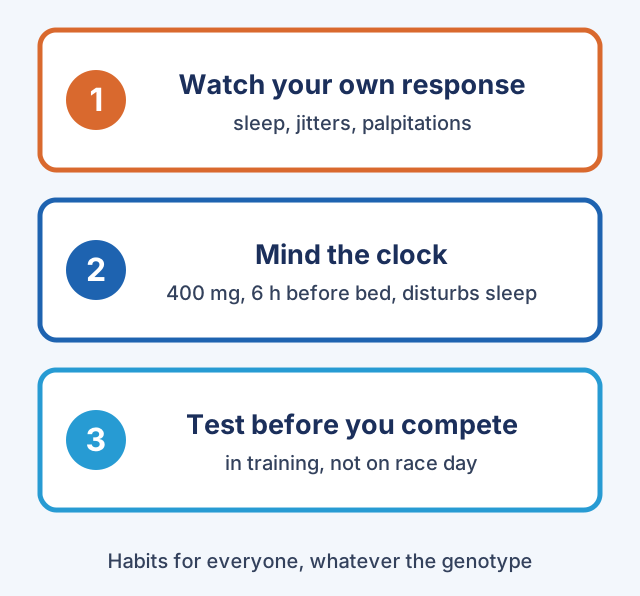
Watch your own response. Note how many coffees you drink, at what time, and how you sleep and feel. That, together with your genotype if you know it, tells you where to fine-tune.
Mind the clock. A trial with 400 mg of caffeine saw sleep disturbance even when it was taken 6 hours before bedtime (Drake and colleagues, 2013); if you sleep badly, bring your last dose forward or reduce the amount.
If you do endurance sport, test before you compete. In the studies of caffeine and CYP1A2, AA people improved more and CC people (only 8 athletes) did worse with the high dose (Guest and colleagues, 2018). Try caffeine in training and compare; do not debut it on race day.
If you carry a C and drink several coffees a day, have your blood pressure checked. In a case-control study of heart attack and in a cohort of young people with stage 1 hypertension, that group showed more risk with high consumption (Cornelis and colleagues, 2006; Palatini and colleagues, 2009); it is a reason to talk to your health professional, not to give up coffee.
If you are TT at rs5751876 and notice jitters, adjust your serving. In two independent studies, anxiety rose more in TT people after 150 mg of caffeine (Alsene and colleagues, 2003; Childs and colleagues, 2008); try a smaller amount per serving or earlier in the day.
Ask for interpretation with context. If you have your genotype, read it alongside your sleep, your blood pressure and your sport, with your health professional: that way it becomes a useful clue and not a label.
This is how genetic information improves eating: it does not decide for you, but it tells you where to look and what to try.
Sources
- Functional significance of a C-->A polymorphism in intron 1 of the cytochrome P450 CYP1A2 gene tested with caffeine, Sachse C et al. British Journal of Clinical Pharmacology 47:445-449 (PMID 10233211), 1999
- Impact of smoking, smoking cessation, and genetic polymorphisms on CYP1A2 activity and inducibility, Dobrinas M et al. Clinical Pharmacology & Therapeutics 90:117-125 (PMID 21593735), 2011
- Induction of CYP1A2 by heavy coffee consumption in Serbs and Swedes, Djordjevic N et al. European Journal of Clinical Pharmacology 64:381-385 (PMID 18157525), 2008
- The influence of a CYP1A2 polymorphism on the ergogenic effects of caffeine, Womack CJ et al. Journal of the International Society of Sports Nutrition 9:7 (PMID 22420682), 2012
- Caffeine, CYP1A2 genotype, and endurance performance in athletes, Guest N et al. Medicine & Science in Sports & Exercise 50:1570-1578 (PMID 29509641), 2018
- Caffeine, CYP1A2 genotype, and exercise performance: a systematic review and meta-analysis, Barreto G et al. Medicine & Science in Sports & Exercise 56:328-339 (PMID 37844569), 2024
- CYP1A2 genotype variations do not modify the benefits and drawbacks of caffeine during exercise: a pilot study, Salinero JJ et al. Nutrients 9:269 (PMID 28287486), 2017
- Coffee, CYP1A2 genotype, and risk of myocardial infarction, Cornelis MC et al. JAMA 295:1135-1141 (PMID 16522833), 2006
- CYP1A2 genotype modifies the association between coffee intake and the risk of hypertension, Palatini P et al. Journal of Hypertension 27:1594-1601 (PMID 19451835), 2009
- Association of coffee drinking with mortality by genetic variation in caffeine metabolism: findings from the UK Biobank, Loftfield E et al. JAMA Internal Medicine 178:1086-1097 (PMID 29971434), 2018
- Association between A2a receptor gene polymorphisms and caffeine-induced anxiety, Alsene K et al. Neuropsychopharmacology 28:1694-1702 (PMID 12825092), 2003
- Association between ADORA2A and DRD2 polymorphisms and caffeine-induced anxiety, Childs E et al. Neuropsychopharmacology 33:2791-2800 (PMID 18305461), 2008
- A genetic variation in the adenosine A2A receptor gene (ADORA2A) contributes to individual sensitivity to caffeine effects on sleep, Rétey JV et al. Clinical Pharmacology & Therapeutics 81:692-698 (PMID 17329997), 2007
- A genome-wide association study of caffeine-related sleep disturbance: confirmation of a role for a common variant in the adenosine receptor, Byrne EM et al. Sleep 35:967-975 (PMID 22754043), 2012
- Caffeine effects on sleep taken 0, 3, or 6 hours before going to bed, Drake C et al. Journal of Clinical Sleep Medicine 9:1195-1200 (PMID 24235903), 2013
- Genome-wide meta-analysis identifies regions on 7p21 (AHR) and 15q24 (CYP1A2) as determinants of habitual caffeine consumption, Cornelis MC et al. PLoS Genetics 7:e1002033 (PMID 21490707), 2011
- Genome-wide meta-analysis identifies six novel loci associated with habitual coffee consumption, Coffee and Caffeine Genetics Consortium. Molecular Psychiatry 20:647-656 (PMID 25288136), 2015
- Genome-wide association study of caffeine metabolites provides new insights to caffeine metabolism and dietary caffeine-consumption behavior, Cornelis MC et al. Human Molecular Genetics 25:5472-5482 (PMID 27702941), 2016
- Ensembl and dbSNP, rs762551, rs5751876, rs4410790 and rs2472297: alleles, forward strand, consequence and 1000 Genomes Project frequencies (GRCh38), NCBI dbSNP and Ensembl, consulted on 06/11/2026, 2026
Educational content from CESGEN, based on the evidence published up to the review date. It does not replace individual medical or dietary advice: to apply it to your own case, talk it through with your health professional. Nutrigenetics is an evolving field, and we review each piece when the evidence changes.