Choline: the nutrient almost nobody counts
Choline is an essential nutrient that your liver makes only in part. What the evidence says about the PEMT gene and oestrogen, and which foods supply it.
Choline is an essential nutrient that is rarely counted: your liver makes some of it, and the rest has to arrive with food (egg, fish, soya and pulses, nuts, liver). In a region of the PEMT gene there is a common variant that, in women who ate a diet almost without choline, was associated with a greater chance of ending up with signs of choline shortage; in men that difference was not seen. A practical recommendation follows: keep choline in mind when planning meals and, if you are a woman and carry the variant (especially after the menopause), give priority to the foods that supply the most choline. For now, that priority is an exploratory suggestion.
One letter, one change
The PEMT gene, on chromosome 17, makes the enzyme phosphatidylethanolamine N-methyltransferase, which forms new choline in the liver inside phosphatidylcholine, a component of cell membranes. It is the only source of choline apart from the diet (Fischer and colleagues, 2007). The variant studied is rs12325817, a letter in the regulatory region of PEMT (in the papers, −744G>C in the promoter; in Ensembl, in an intron of the main transcripts). It does not change the protein: it marks a haplotype that, in human hepatocytes, responded less to oestrogen (Resseguie and colleagues, 2011). The allele associated with a greater chance of signs of choline shortage, which the papers call C, is common: it appears in 46% of European chromosomes, 36% of the American-ancestry group, 18% of East and South Asians and 7% of Africans in the 1000 Genomes Project. Two copies were found in 24% of a group of European Americans and 0% of a group of people of African descent (da Costa and colleagues, 2014).
A peculiarity for reading your file: the PEMT gene is read in the opposite direction to the forward strand of the reference genome, so in dbSNP and in forward-strand files rs12325817 appears as C/G, not G/C. The papers use the letters of the gene: their C allele is the G in the file, and their G allele is the C in the file. This entry always gives both forms.
The mechanism, step by step
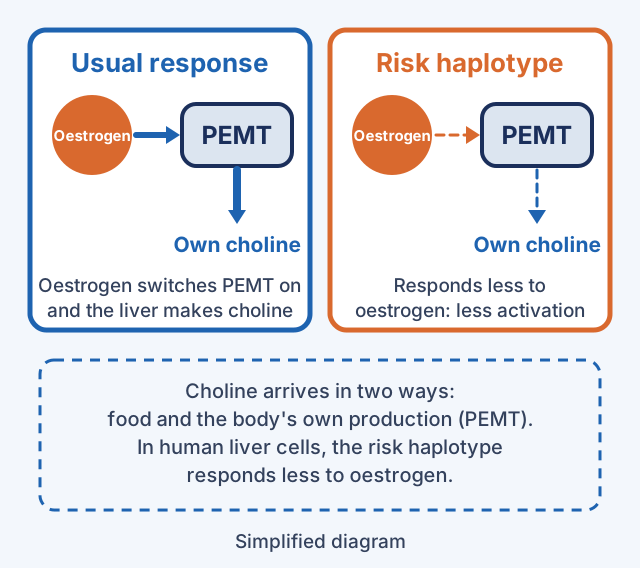
1. The liver makes its own choline. The enzyme PEMT methylates phosphatidylethanolamine using S-adenosylmethionine as the methyl donor and forms a new choline moiety (Fischer and colleagues, 2007).
2. Oestrogen switches that factory on. In laboratory animals, females seem to have more PEMT activity than males, and oestrogen is important for it (Fischer and colleagues, 2007). In people deprived of choline, signs of choline shortage (fatty liver or muscle damage) developed in 77% of the men and 80% of the postmenopausal women, against 44% of the premenopausal women (Fischer and colleagues, 2007). Among postmenopausal women, signs developed in 2 of 11 given oestrogen (18%) and 8 of 11 given a placebo (73%), one of them already in the baseline phase, before the diet without choline (Fischer and colleagues, 2010).
3. The haplotype responds less to oestrogen. In human hepatocytes, the haplotype associated with a higher risk of choline shortage, marked by rs12325817 and a neighbouring SNP (rs4646343), lost the binding of the oestrogen receptor and of FOXA1, and with it the activation of PEMT by oestrogen (Resseguie and colleagues, 2011). rs12325817 lies within 1 kb of the element that responds to oestrogen, but it is not inside the binding site, and the authors could not say which SNP in the region is responsible.
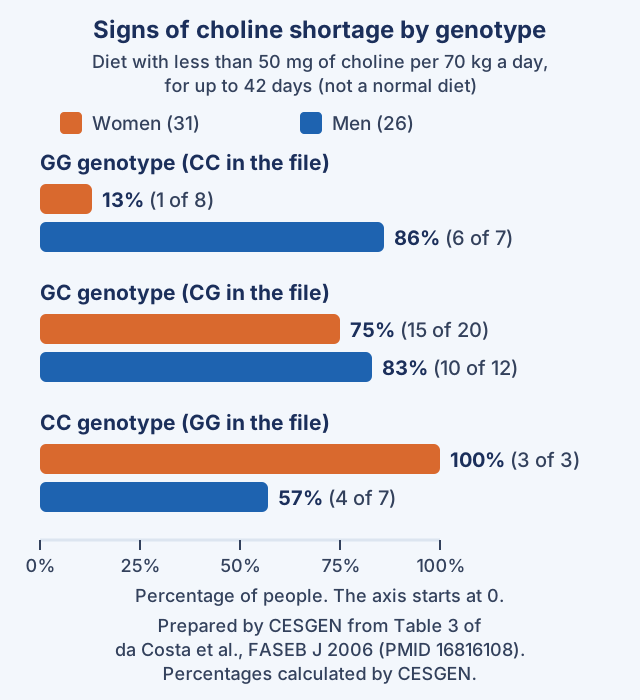
4. With little choline in the diet, the difference shows. On a diet of less than 50 mg of choline per 70 kg of body weight a day for up to 42 days, women with the variant developed signs more often (da Costa and colleagues, 2006; Fischer and colleagues, 2010). The signs went away when choline was put back (Fischer and colleagues, 2007).
How confident are we? That oestrogen regulates PEMT and that, without oestrogen, choline shortage is more likely has been seen in trials with people (Fischer and colleagues, 2007, 2010). That this variant, as a marker of a haplotype, is associated with a greater chance of signs comes from a single research programme: volunteers in North Carolina (79 people, 53 women) analysed in several papers by one group, which do not amount to a replication by an independent team. It was also seen on a diet almost without choline, not on everyday food. That is why the recommendation by genotype is exploratory.
Genotype and diet: what the evidence says
The practical question is whether your genotype changes what you should eat. What has been published allows an answer for women and for men separately. The table reflects what the studies saw in groups of people and is not an assessment of your case. The genotypes are named as in the papers (GG, GC, CC) and, in brackets, as you will see them in a genetic file (forward-strand letters).
| Your genotype | What has been observed | What you can do | Evidence |
|---|---|---|---|
| Woman, GG (CC in the file): no copy of the effect allele | On the diet almost without choline, signs developed in 1 of 8 women (13%; da Costa and colleagues, 2006) and 1 of 8 premenopausal women (Fischer and colleagues, 2010). | GG was the group with the fewest signs in these studies, so your gene does not point to a greater need. Keep a varied diet with sources of choline (egg, fish, soya or pulses, nuts) and compare the choline in your diet with EFSA's adequate intake (400 mg a day for adults), a population guide rather than a measure of your personal need. | Exploratory, not actionable |
| Woman, GC (CG or GC): one copy | Signs developed in 75% of the women (15 of 20; da Costa and colleagues, 2006) and 43% of the premenopausal women (6 of 14; Fischer and colleagues, 2010). | As an exploratory suggestion, include choline-rich foods regularly (for example egg, fish, soya or pulses) and check that your diet is not low in them. | Exploratory, not actionable |
| Woman, CC (GG in the file): two copies | Signs developed in 3 of 3 women (da Costa and colleagues, 2006) and 4 of 5 premenopausal women (80%; Fischer and colleagues, 2010). | As an exploratory suggestion, make the foods that supply the most choline per portion a priority (egg, liver, fish, soya and pulses), with more reason after the menopause; if you eat little food of animal origin, rely on soya and pulses and add nuts and broccoli. | Exploratory, not actionable |
| Man, any genotype | Signs developed in 86% of those with GG (6 of 7), 83% with GC (10 of 12) and 57% with CC (4 of 7), unrelated to the number of copies (P = 0.49; da Costa and colleagues, 2006). Six men had signs even on the study's baseline diet, which provided 550 mg per 70 kg of body weight a day (Fischer and colleagues, 2007). | In the men studied, no genotype at rs12325817 pointed to lower susceptibility. Compare the choline in your diet with EFSA's adequate intake (400 mg a day for adults) and check whether it falls short: some men showed signs even on the study's baseline diet, which provided 550 mg per 70 kg of body weight a day. | Exploratory, not actionable |
Women
In 31 women who ate the diet almost without choline, signs developed in 18 of the 23 carriers of the C allele (78%) and in 1 of the 8 without it (OR 25; 95% confidence interval, 2 to 256; P = 0.002), with a very wide interval because the group was small (da Costa and colleagues, 2006). In 27 premenopausal women there was a rising relationship with the number of copies: signs developed in 13% with none, 43% with one and 80% with two (P = 0.02; Fischer and colleagues, 2010). Among postmenopausal women on placebo, signs developed in all 7 carriers and in 1 of the 4 who were not (P = 0.02); with oestrogen, in 2 of the 5 carriers (Fischer and colleagues, 2010). When the 79 volunteers were re-analysed with 200 variants in choline genes and corrected for multiple testing, rs12325817 remained associated in the 53 women together (adjusted P = 0.0074) and in the 26 postmenopausal women (adjusted P = 0.031); in the premenopausal women on their own, in the men and in the 79 together, no variant passed the correction (da Costa and colleagues, 2014). EFSA identifies rs12325817 as the variant studied most often in these very-low-choline trials. Signs were more likely in postmenopausal than premenopausal women, and when folate was also restricted. Given the trial designs and the lack of data on habitual diets, EFSA cannot confidently predict how much choline prevents those signs (EFSA, 2016).
Men
In 26 men, the frequency of signs did not follow the number of copies of the allele (P = 0.49; da Costa and colleagues, 2006). On the diet almost without choline, signs developed in 77% of them, whatever the genotype (Fischer and colleagues, 2007), so at this gene no genotype pointed to a different susceptibility in men.
What are these recommendations based on?
The base is to meet the adequate intake of choline with food, which applies to everyone: EFSA sets 400 mg a day for adults, 480 in pregnancy and 520 in breastfeeding (EFSA, 2016). It is not an individual requirement: EFSA could calculate neither an Average Requirement nor a Population Reference Intake. It based the adequate intake of 400 mg a day mainly on mean intakes observed in healthy EU populations, while considering a small study in which 18 of 25 participants with signs and available repletion data recovered on up to about 400 mg per 70 kg of body weight a day. The same panel notes that variants in choline enzymes, PEMT among them, can influence the need for choline and the susceptibility to its shortage, but that the data are not enough to predict individual requirements from genotype (EFSA, 2016). On top of it, the recommendations by genotype for women rest on a plausible mechanism in cells (Resseguie and colleagues, 2011), on the effect of oestrogen in trials, and on an association found in a single research programme, with a depletion diet and few volunteers. That is why they are exploratory suggestions for reviewing the diet and observing whether it covers the sources of choline (‘Exploratory, not actionable’), not established guidance. For men, the recommendation is the base plus a check that the diet does not fall short, because no difference by genotype was seen. None of the studies cited tested a change in diet, or a supplement, according to this genotype.
Where is choline?
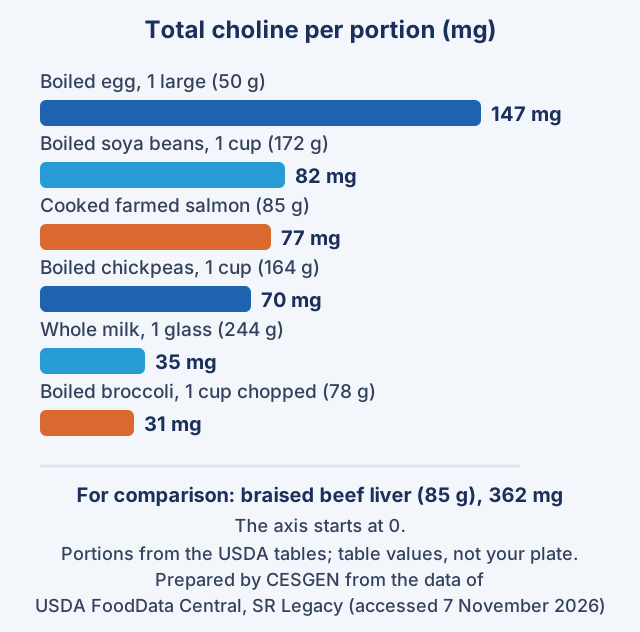
EFSA notes that the choline content is highest in eggs, followed by meat and fish, whole grains, vegetables and fruit (EFSA, 2016). According to the USDA tables, a large boiled egg provides about 147 mg of choline, and 85 g of braised beef liver about 362 mg. Among the foods in the figure, egg and boiled soya supply the most per portion; salmon (77 mg), chickpeas (70), milk (35) and broccoli (31) supply less per portion but add up, and soya and pulses are options without animal products. You do not need to eat them all every day: it is a sample of which foods count. Across food consumption surveys from seven EU countries reviewed by EFSA, estimated mean intakes ranged from 332 to 468 mg a day for adult men and from 269 to 404 mg for adult women; the estimates used US food composition data (EFSA, 2016).
If you have a genetic file
If your file is from 23andMe or AncestryDNA, look for rs12325817 (the steps are in the genetic file guide). This entry uses the letters of the forward strand of the reference genome (the dbSNP one). Because PEMT is on the reverse strand, they do not match the papers: at rs12325817 you will see C and G where the papers write G and C. Check the header or the documentation of your file to see which strand it uses before applying the table. If your file were on the other strand, you would see G and C directly, the letters the papers use, and the names in the table would match what you see.
| What you will see in your file | What this entry calls it | What has been observed |
|---|---|---|
| rs12325817: CC | GG genotype (no copy of the effect allele) | In women, the genotype with the fewest signs of choline shortage; in men, unrelated to genotype |
| rs12325817: CG or GC | GC genotype (one copy) | In women, more signs than with GG and fewer than with CC; in men, unrelated to genotype |
| rs12325817: GG | CC genotype (two copies) | In women, the genotype with the most signs; in men, unrelated to genotype |
| Any other combination (for example an A or a T, or dashes or zeros) | Cannot be determined with this file | Check the strand and format of your file before interpreting |
This entry uses only rs12325817. In the studies, two other PEMT SNPs were largely inherited together with it, rs4646343 (r² = 0.83) and rs3760188 (r² = 0.90), and were associated in the same way (da Costa and colleagues, 2014), but they are not needed to apply the table.
Three more warnings. The chip behind your file may not include this variant; if you cannot find it, check whether your chip and file format include it. If it appears with dashes or zeros instead of letters, check how your file marks positions that were not read. And no variant can tell you on its own how much choline you need. This table describes what has been observed in studies and does not replace the assessment of a health professional.
What to bear in mind when applying it
A diet almost without choline is not your diet. The volunteers ate less than 50 mg of choline per 70 kg a day, under a tenth of the study's baseline diet (550 mg per 70 kg a day), for up to 42 days, and the signs went away when it was put back (Fischer and colleagues, 2007). These data speak about sensitivity to choline shortage, not about what happens on an ordinary diet.
It is a single research programme. The results of 2006 and 2010 come from cohorts recruited at different times by the same group in North Carolina, and the 2014 analysis brings together data from those studies (79 people, 53 women, 66% of European ancestry; the 2010 and 2014 papers cite the same registered trial, NCT00065546). They do not amount to a replication by an independent team. Other groups measured other things: in 43 premenopausal Mexican American women on a constant 349 mg of choline a day and restricted folate, those with CC had a smaller fall in phosphatidylcholine than those with GG (P = 0.017; Ivanov and colleagues, 2009), and in 103 pregnant Polish women the variant was associated with betaine, not choline (Chmurzynska and colleagues, 2018). In other words, the effect on other markers does not always point in the same direction.
Funding and conflicts of interest. The 2007 study by Fischer and colleagues was funded by the US National Institutes of Health, and the company Solae provided the lecithin used in the diets in 2007 and 2010. The last author, S. H. Zeisel, reports grant support from Mead Johnson Nutritionals and the Egg Nutrition Research Center for other studies and, in the 2010 paper, serving on an advisory board for Solae. Neither paper reports other financial conflicts of interest in relation to the study described. This is information for you to have; it does not invalidate the results.
Oestrogen is not a dietary recommendation. In one trial, oestrogen reduced the signs in postmenopausal women, which supports the mechanism (Fischer and colleagues, 2010). This entry proposes nothing about hormone treatment: that is for each person to decide with their doctor.
Pregnancy and breastfeeding have their own guidance. EFSA sets an adequate intake of 480 mg a day in pregnancy and 520 in breastfeeding (EFSA, 2016). In 103 pregnant Polish women, the average choline intake was 365 mg a day and most did not reach the adequate intake (Chmurzynska and colleagues, 2018). This entry proposes no changes by genotype at those stages: the guidance comes from official recommendations and your health professional.
There are differences between populations. The frequency of the effect allele varies a great deal: from 7% in Africans to 46% in Europeans (1000 Genomes). The studies cited come from volunteers in North Carolina, mostly of European ancestry.
This entry does not recommend supplements because of a variant. None of the studies cited tested a choline supplement according to this genotype. If your health professional suggests one, that is their decision, not something this entry provides.
What you can do with this information
Keep choline in mind. The adequate intake for adults is 400 mg a day (EFSA, 2016). Egg and liver are the most concentrated sources; fish, soya and pulses give similar amounts per portion, and nuts and broccoli add smaller amounts (USDA). If your diet is plant-based, soya and pulses are the way to reach it, with nuts and broccoli as a complement.
Give choline the priority that fits your genotype. If you are a GG woman, keep a varied diet with sources of choline and compare the choline in your diet with EFSA's adequate intake. As an exploratory suggestion, if you are a GC woman, include choline-rich foods regularly and check that your diet is not low in them; if you are a CC woman, make the foods that supply the most per portion a priority (egg, liver, fish, soya and pulses), especially after the menopause. If you are a man, no genotype at this gene pointed to a different susceptibility: compare the choline in your diet with EFSA's adequate intake and check whether it falls short.
Vary your diet. Choline comes from many foods and works alongside other nutrients, such as folate and betaine (Ivanov and colleagues, 2009): a varied diet covers more than one at a time.
If you are pregnant or breastfeeding, or your diet is very low in choline-rich foods, tell your health professional. If you know your genotype, you can mention it so that they consider it alongside your diet. If a supplement is needed, that decision is theirs.
Ask for the result to be interpreted in the light of your situation. If you know your genotype, ask your health professional to interpret it taking into account your sex, your stage of life and your diet: that way it becomes a useful clue and not a label.
This is how genetic information improves eating: it does not decide for you, but it points to which nutrient deserves more attention.
Sources
- Common genetic polymorphisms affect the human requirement for the nutrient choline, da Costa KA et al. FASEB Journal 20:1336-1344 (PMID 16816108), 2006
- Sex and menopausal status influence human dietary requirements for the nutrient choline, Fischer LM et al. American Journal of Clinical Nutrition 85:1275-1285 (PMID 17490963), 2007
- Dietary choline requirements of women: effects of estrogen and genetic variation, Fischer LM et al. American Journal of Clinical Nutrition 92:1113-1119 (PMID 20861172), 2010
- Aberrant estrogen regulation of PEMT results in choline deficiency-associated liver dysfunction, Resseguie ME et al. Journal of Biological Chemistry 286:1649-1658 (PMID 21059658), 2011
- Identification of new genetic polymorphisms that alter the dietary requirement for choline and vary in their distribution across ethnic and racial groups, da Costa KA et al. FASEB Journal 28:2970-2978 (PMID 24671709), 2014
- Genetic variants in phosphatidylethanolamine N-methyltransferase and methylenetetrahydrofolate dehydrogenase influence biomarkers of choline metabolism when folate intake is restricted, Ivanov A et al. Journal of the American Dietetic Association 109:313-318 (PMID 19167960), 2009
- PEMT rs12325817 and PCYT1A rs7639752 polymorphisms are associated with betaine but not choline concentrations in pregnant women, Chmurzynska A et al. Nutrition Research 56:61-70 (PMID 30055775), 2018
- Dietary Reference Values for choline, EFSA Panel on Dietetic Products, Nutrition and Allergies (NDA). EFSA Journal 14(8):4484, 2016
- USDA FoodData Central, SR Legacy: total choline of boiled egg, braised beef liver, cooked farmed salmon, boiled soya beans, boiled chickpeas, whole milk and boiled broccoli, US Department of Agriculture, accessed 7 November 2026, 2019
- Ensembl and dbSNP, rs12325817: alleles, forward strand, consequence in the PEMT transcripts and 1000 Genomes frequencies (GRCh38), NCBI dbSNP and Ensembl, accessed 7 November 2026, 2026
Educational content from CESGEN, based on the evidence published up to the review date. It does not replace individual medical or dietary advice: to apply it to your own case, talk it through with your health professional. Nutrigenetics is an evolving field, and we review each piece when the evidence changes.