How well does your body turn carrots into vitamin A?
A gut enzyme, BCO1, turns beta-carotene into vitamin A. How much people differ, and how to get more out of your carrots.
Carrots do not contain vitamin A as such: they contain beta-carotene, and it is your body that transforms it. That transformation differs from one person to another, and one of the pieces involved is a gene, BCO1. Knowing this helps with something very practical: getting more out of carrots, sweet potato or spinach with three kitchen habits that work whatever your genotype. Put some fat in the same meal, cook or purée the vegetable, and combine it with foods that already contain vitamin A.
One letter, one change
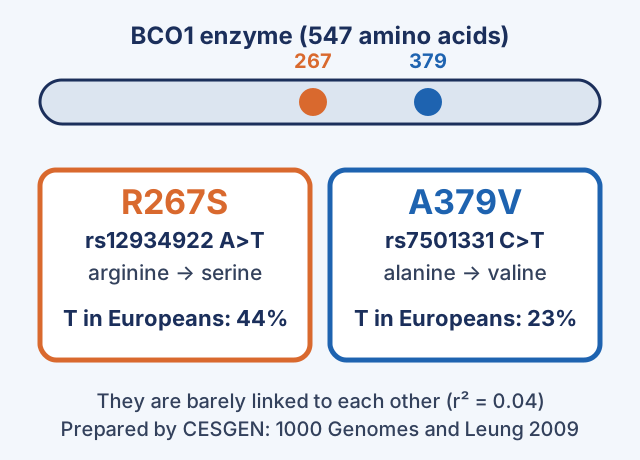
The BCO1 gene (formerly called BCMO1) is on chromosome 16 and makes the enzyme that cuts beta-carotene. In European populations there are two common variants that change one amino acid of that enzyme (Leung and colleagues, 2009). The first is rs12934922: an A becomes a T and the arginine at position 267 becomes serine (R267S). The second is rs7501331: a C becomes a T and the alanine at position 379 becomes valine (A379V). The gene is on the forward strand of the reference genome, so the dbSNP letters and the gene's letters are the same.
The T allele is common. In the 1000 Genomes Project it appears in 44% of European chromosomes for rs12934922 and in 23% for rs7501331 (in Iberians, 46% and 18%). In 131 volunteers in the United Kingdom, Leung and colleagues found 42% and 24%, and saw that the two variants are barely linked (r² = 0.04): they are inherited almost independently, so some people carry one, the other, both or neither.
The mechanism, step by step
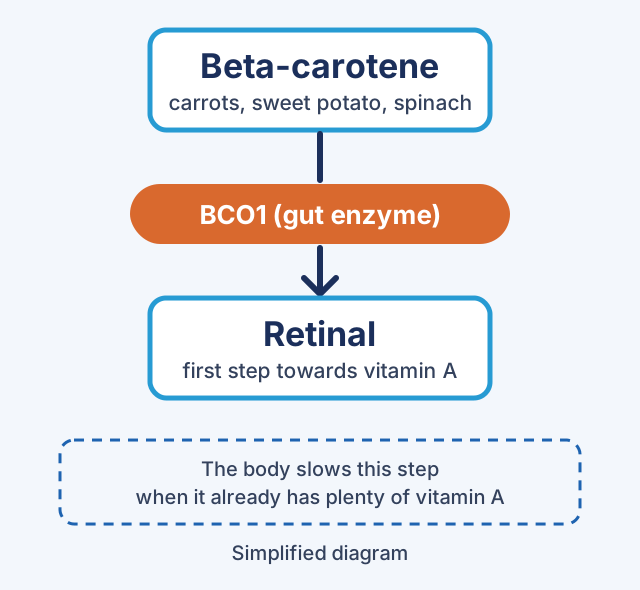
1. Beta-carotene arrives with fat. It is a fat-soluble molecule: to be absorbed in the gut it needs fat in the same meal (Brown and colleagues, 2004; more on this in the last section).
2. BCO1 cuts it. Inside the cells of the gut, the BCO1 enzyme breaks beta-carotene at its central bond (15,15') and produces retinal (dela Seña and colleagues, 2013). Because beta-carotene has 40 carbons and retinal has 20, each molecule gives two of retinal (Kowatz and colleagues, 2013). Retinal is the first step towards vitamin A (Lobo and colleagues, 2010).
3. The variants change the enzyme. In the laboratory, the recombinant enzyme with both changes together (267S and 379V) formed 1.0 nmol of retinal per milligram of protein per minute, against 2.3 for the usual enzyme: an activity 57% lower, with no change in its affinity for beta-carotene (Leung and colleagues, 2009). Neither change on its own reduced the activity significantly in that assay.
4. The body regulates the factory. When there is plenty of vitamin A, retinoic acid activates a transcription factor in the gut called ISX, which lowers the production of BCO1 and of the SR-BI receptor that helps to take up beta-carotene. This negative feedback has been described in mice and in human cells (Lobo and colleagues, 2010).
How sure are we? That BCO1 converts beta-carotene into retinal is very well established. That these two variants change conversion in people rests on one study of 28 young women. The association of the BCO1 region with carotenoid levels in blood has been replicated in large cohorts, although with other nearby variants: in three cohorts with 3,941 people, the variant rs6564851 was associated with more beta-carotene in blood but not with retinol (Ferrucci and colleagues, 2009), and in 2,344 women of European descent, a score built from two or three BCO1 variants was associated with differences of 48% in plasma beta-carotene between the extreme quintiles (Hendrickson and colleagues, 2012).
Genotype and diet: what the evidence says
The practical question is whether your genotype changes what is best for you to eat. What has been published about these two variants allows an answer with some nuance. The table describes what has been observed in one particular study, in a group of women, and not anyone's individual case; the letters are those of the forward strand of the reference genome.
Leung and colleagues (2009) gave 28 women aged 19 to 26, after a 12-hour fast, a single dose of 120 mg of beta-carotene with a high-fat meal. Three hours later they measured, in the triglyceride-rich lipoproteins (which reflect what the gut has just absorbed), the ratio of retinyl palmitate, a form of vitamin A, to beta-carotene: the lower it is, the less conversion. The values in the table are those adjusted by the authors.
| Your genotype | What has been observed | What you can do | Evidence |
|---|---|---|---|
| rs12934922 AA and rs7501331 CC | 17 volunteers: retinyl palmitate to beta-carotene ratio of 0.585 and fasting beta-carotene of 276 nmol/l | The study showed the highest conversion in your group (after a pharmacological dose): try making well-prepared carrots one of your main sources of vitamin A (Tang and colleagues, 2005) and apply the three habits in the last section. | Exploratory, not actionable |
| At least one T in rs7501331 (and AA in rs12934922) | 7 volunteers: ratio of 0.305 (P = 0.005) and fasting beta-carotene of 586 nmol/l (P = 0.025) | Conversion was lower in the study: apply the three habits and try regularly including foods that already contain retinol (eggs, whole milk); this is an exploratory emphasis. | Exploratory, not actionable |
| At least one T in rs12934922 and at least one T in rs7501331 | 4 volunteers: ratio of 0.156 (P = 0.001) and fasting beta-carotene of 697 nmol/l (P = 0.041) | This group had the lowest conversion in the study: apply the three habits and try putting ready-made retinol first (eggs, whole milk); carrots still add up. This is an exploratory emphasis. | Exploratory, not actionable |
| At least one T in rs12934922 and CC in rs7501331 | The 28-volunteer trial reports no outcome for this combination | The study reports no results for this combination: start from the three habits and, as an exploratory adjustment, include foods with retinol as well. | Exploratory, not actionable |
What are these recommendations based on? The three habits rest on trials in people whose genotype was not looked at and which measured different things: fat improved the absorption of carotenoids (Brown and colleagues, 2004); cooking and puréeing were accompanied by a larger rise of beta-carotene in blood, with a borderline difference (Rock and colleagues, 1998); and varying your sources is practical advice, not an intervention tested for conversion. What the genotype adds is the emphasis: what was observed are differences in conversion after a pharmacological dose of beta-carotene, not in what happens with everyday food, and no studies have tested a different diet according to these genotypes; so the emphasis on ready-made retinol for people who carry a T is an exploratory recommendation, based on the observations and the mechanism, and it comes down to ordinary foods.
On the levels of evidence: the association of the BCO1 region with carotenoids in blood has been replicated (‘Replicated association, uncertain clinical utility’). The effect of these two particular variants on conversion comes from one small study and from laboratory assays (‘Exploratory, not actionable’), so the emphasis by genotype is offered as a reasonable hypothesis to try, not as established advice.
If you have a genetic file
If your file is from 23andMe or AncestryDNA, look for rs12934922 and rs7501331 (the steps are in the genetic file guide). This entry uses the letters of the forward strand of the reference genome (the dbSNP one); check the header or the documentation of your file to see which strand it uses before applying the tables.
One warning specific to rs12934922: the A and T alleles discussed here are complementary letters (the site also has a G, which does not change the amino acid). If your file were on the other strand, an AA would read as TT and the other way round, and you cannot tell by looking at the letters alone. If you have not checked the strand of your file, treat that variant as ‘cannot be determined’. This does not happen with rs7501331 (C and T): on the other strand they would be G and A.
| What you will see in your file | What this entry calls it |
|---|---|
| rs12934922: AA | Two copies of R267, the usual form |
| rs12934922: AT or TA | One copy of 267S |
| rs12934922: TT | Two copies of 267S |
| rs7501331: CC | Two copies of A379, the usual form |
| rs7501331: CT or TC | One copy of 379V |
| rs7501331: TT | Two copies of 379V |
To see which group in the study your combination would resemble:
| rs12934922 | rs7501331 | Group in the study by Leung and colleagues |
|---|---|---|
| AA | CC | Reference (0.585) |
| AA | CT or TT | ‘379V’ (0.305) |
| AT or TT | CT or TT | ‘267S + 379V’ (0.156) |
| AT or TT | CC | The 28-volunteer trial reports no outcome for this group |
| Any other, or not read | Cannot be determined with this file |
Three more points. The chip used for your file may not include one of the two variants; if you cannot find it, it was not measured. If it appears with dashes or zeros instead of letters, check how your file marks positions that were not read. And a file does not say which chromosome copy each letter is on: someone with a T in each variant may have them on the same copy of the gene or on different copies, and the study comments that, because the two are not linked, it is unlikely that they always sit on the same copy. This table describes what has been observed in studies and does not replace an assessment by a health professional.
What to bear in mind when applying it
It is a small study with a high dose. The groups were 17, 7 and 4 volunteers, all young and recruited in Newcastle. They were given 120 mg of beta-carotene at once, about 100 times what they ate on average in a day (1.2 mg). The authors themselves point out that the 379V change alone did not alter the enzyme in the test tube, although it was associated with less conversion in the volunteers, and they put forward several possible explanations that remain unconfirmed.
A note on the figures in the original paper. The percentages in the abstract of Leung and colleagues (reductions of 32% and 69%) do not match the adjusted values the paper itself gives in the Results, and the Results text speaks of a 43% loss of activity in vitro that the figures (1.0 against 2.3) and the discussion put at 57%. Here we quote the adjusted values and the 57%.
People vary a lot, with or without these variants. In the reference group, the retinyl palmitate to beta-carotene ratio had a coefficient of variation of 46% (Leung and colleagues, 2009). In seven men, between 7.7 and 24.5 mg of carrot beta-carotene were needed to form 1 mg of retinol, a variation of more than threefold (Tang and colleagues, 2005); that study did not look at genotype.
The two variants are not the whole story. Other variants near the gene, upstream of it, were also associated with a lower estimated conversion, between 48% and 59% in volunteers (Lietz and colleagues, 2012), and with carotenoid levels in blood (Ferrucci and colleagues, 2009).
Populations differ. The T allele of rs7501331 is rare in African populations (about 1% in the 1000 Genomes Project), and the studies cited were done mainly in people of European descent.
A genotype does not measure your vitamin A level. This entry does not suggest vitamin A supplements: an excess of preformed vitamin A taken as a supplement has recognised adverse effects (Leung and colleagues, 2009), so any supplement is decided with a health professional and not on the basis of one variant.
What you can do with this information
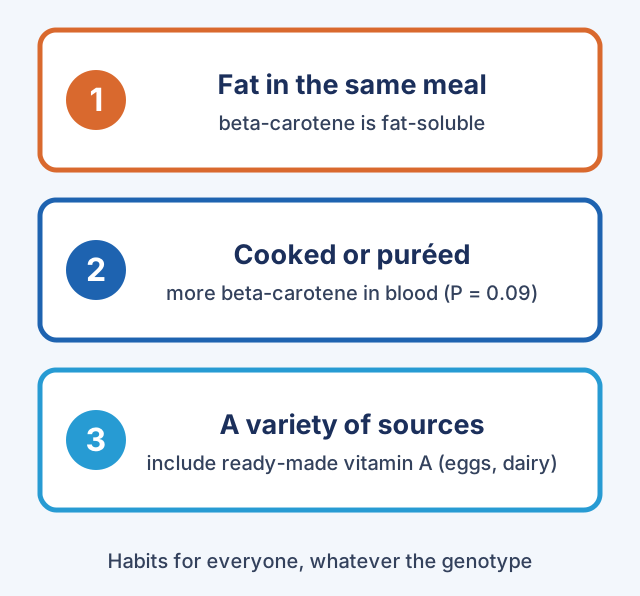
Put some fat in the same meal. In a trial with seven adults who ate salads of spinach, lettuce, cherry tomatoes and carrots, with a fat-free dressing almost no alpha-carotene, beta-carotene or lycopene appeared in the chylomicrons, the particles that carry absorbed fat. With 6 g of canola oil more appeared, and with 28 g, more still (Brown and colleagues, 2004). Include a source of fat with that meal, for example oil on your salad or in a carrot soup.
Cook or purée the vegetable. In a crossover trial with eight women, beta-carotene in blood rose over four weeks about three times more with carrots and spinach that had been heat-processed and puréed than with the same vegetables raw; the direct difference was borderline (P = 0.09) (Rock and colleagues, 1998). A purée, a soup or a cooked carrot all fit that habit.
Vary your sources of vitamin A. Carrots are a good source: in the study with deuterium-labelled vegetables, 14.8 mg of carrot beta-carotene was equivalent on average to 1 mg of retinol, better than spinach (20.9 to 1) (Tang and colleagues, 2005). If you also eat foods that already contain retinol, such as eggs (about 160 µg per 100 g) or whole milk (about 45 µg), that part of your vitamin A does not need to go through BCO1 (USDA FoodData Central).
Fine-tune the emphasis for your genotype. If you are AA at rs12934922 and CC at rs7501331, the study showed the highest conversion in your group after a pharmacological dose: try making well-prepared carrots, with some fat, one of your main sources of vitamin A. If you carry a T at rs7501331 (with AA at rs12934922) or a T at both variants, conversion was lower in the study: besides the three habits, try regularly including foods that already contain retinol, such as eggs or whole milk. If you carry a T at rs12934922 and CC at rs7501331, the study reports no results: you can try the same as an exploratory adjustment. The three preparation habits are for everyone, and the emphasis by genotype is exploratory.
Ask for interpretation with context. If you have your genotype, read it alongside your diet and with your health professional: that way it becomes a useful clue and not a label.
This is how genetic information improves eating: it does not decide for you, but it helps you cook your carrots in the way that makes the most of them.
Sources
- Two common single nucleotide polymorphisms in the gene encoding beta-carotene 15,15'-monoxygenase alter beta-carotene metabolism in female volunteers, Leung WC et al. FASEB Journal 23:1041-1053 (PMID 19103647), 2009
- Single nucleotide polymorphisms upstream from the beta-carotene 15,15'-monoxygenase gene influence provitamin A conversion efficiency in female volunteers, Lietz G et al. Journal of Nutrition 142:161S-165S (PMID 22113863), 2012
- Common variation in the beta-carotene 15,15'-monooxygenase 1 gene affects circulating levels of carotenoids: a genome-wide association study, Ferrucci L et al. American Journal of Human Genetics 84:123-133 (PMID 19185284), 2009
- Beta-carotene 15,15'-monooxygenase 1 single nucleotide polymorphisms in relation to plasma carotenoid and retinol concentrations in women of European descent, Hendrickson SJ et al. American Journal of Clinical Nutrition 96:1379-1389 (PMID 23134893), 2012
- ISX is a retinoic acid-sensitive gatekeeper that controls intestinal beta,beta-carotene absorption and vitamin A production, Lobo GP et al. FASEB Journal 24:1656-1666 (PMID 20061533), 2010
- Substrate specificity of purified recombinant human beta-carotene 15,15'-oxygenase (BCO1), dela Seña C et al. Journal of Biological Chemistry 288:37094-37103 (PMID 24187135), 2013
- Characterization of human beta,beta-carotene-15,15'-monooxygenase (BCMO1) as a soluble monomeric enzyme, Kowatz T et al. Archives of Biochemistry and Biophysics 539:214-222 (PMID 23727499), 2013
- Carotenoid bioavailability is higher from salads ingested with full-fat than with fat-reduced salad dressings as measured with electrochemical detection, Brown MJ et al. American Journal of Clinical Nutrition 80:396-403 (PMID 15277161), 2004
- Bioavailability of beta-carotene is lower in raw than in processed carrots and spinach in women, Rock CL et al. Journal of Nutrition 128:913-916 (PMID 9567003), 1998
- Spinach or carrots can supply significant amounts of vitamin A as assessed by feeding with intrinsically deuterated vegetables, Tang G et al. American Journal of Clinical Nutrition 82:821-828 (PMID 16210712), 2005
- Ensembl and dbSNP, rs12934922 and rs7501331: alleles, forward strand, amino acid change and 1000 Genomes Project frequencies (GRCh38), NCBI dbSNP and Ensembl, consulted on 06/11/2026, 2026
- USDA FoodData Central, SR Legacy: whole raw egg (FDC 171287, retinol 160 µg per 100 g) and whole milk (FDC 171265, retinol 45 µg per 100 g), U.S. Department of Agriculture, consulted on 06/11/2026, 2019
Educational content from CESGEN, based on the evidence published up to the review date. It does not replace individual medical or dietary advice: to apply it to your own case, talk it through with your health professional. Nutrigenetics is an evolving field, and we review each piece when the evidence changes.