Which crisps are really made of potato?
We compare the ingredients of 11 snacks as a family tree: some are sliced potato, some are starch dough and some are maize.
Is a Pringle a potato crisp? And a Dorito? If you have ever wondered, this post is for you. Between a bag of classic crisps and a tube of Pringles there is more distance than the word "crisps" suggests. This is the first instalment of Nutrition data science, a series in which we use data-science tools to read what food and nutrition data say, starting with product labels.
The question
On the supermarket shelf, "crisps" is a broad word. It covers thin fried slices of potato, moulded dough stacked in a tube, rings, and maize shapes that are often sold alongside all of them. Reading the ingredient lists shows they are not the same thing, but comparing eleven labels by eye is slow and subjective. Can we measure how alike two products are, and draw the result?
A family tree for foods
Anyone who has worked in evolutionary biology knows the idea: compare the DNA of several species, calculate how similar they are and draw a tree in which the most similar sit on neighbouring branches. FoodTree applies the same procedure to foods, but instead of DNA it compares the composition derived from the label and its nutrition information: how much potato, how much maize, how much flour or starch, how much oil, how much salt and how many additives and flavourings.
For each pair of products a distance is calculated (Bray-Curtis, which measures the share of the composition they do not have in common) and the closest are then merged step by step until the tree is complete. Two products with almost the same recipe end up on neighbouring branches; two with very different recipes, far apart.
Eleven bags, three branches
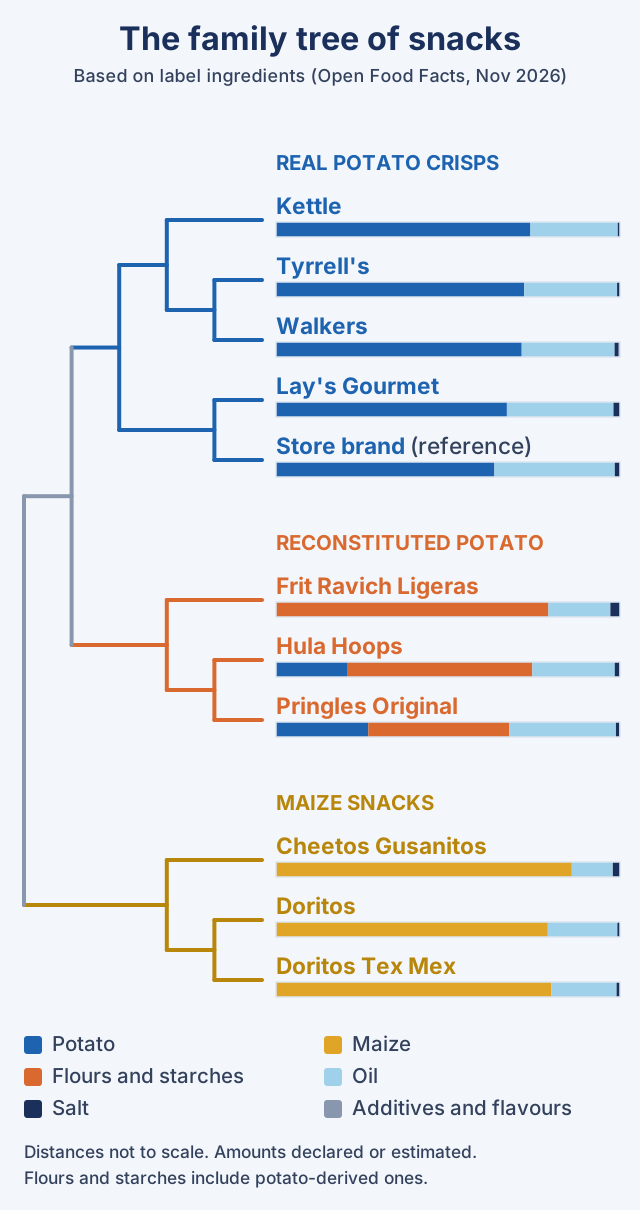
The example brings together eleven products from Spain, the United Kingdom and France: five classic crisps, three moulded snacks based on potato and starches, and three maize snacks. Among the classics we included a store brand with three ingredients (potato, sunflower oil and salt) as a reference for the simplest possible recipe. Amounts are expressed on the finished product, as declared on the label or, where they are not declared, estimated from it.
What the tree shows
The five classic potato crisps form a tight branch: 63% to 74% potato, 25% to 35% oil and under 2% salt. Within it, the three-ingredient store brand looks very like the others; the differences between brands are matters of nuance, not of recipe.
On another branch sit Pringles Original, Hula Hoops and Frit Ravich Ligeras. Here potato is not used in slices but as a dough: dehydrated potato, potato flour and potato starch, sometimes with wheat, maize or rice flour. In Frit Ravich Ligeras, for example, potato flour and starch add up to about 79%. In the chart these derivatives count under "flours and starches", and "potato" covers only whole or dehydrated potato, which in Pringles and Hula Hoops comes to around 21-27% in our estimate (the label gives the order of ingredients, not the amounts). They are a different kind of product: a dough that is moulded and then fried or baked.
On the third branch are the two Doritos and the Cheetos Gusanitos, whose main ingredient is maize, between 79% and 86% of the composition. So the answer to the opening question is "no": according to its label, a Dorito is not a potato product, it is a maize snack. This describes what the manufacturer declares and passes no judgement on the quality of one product or another.
What it does not say
The data come from Open Food Facts, an open, collaborative database where anyone can add or correct products, and were consulted in November 2026; we have not checked them one by one against the physical labels, and a label can change over time. The eleven products are a small sample from three countries, not a study of the market. And since part of the amounts are estimates, the tree is best read as a snapshot of declared recipes, not as a laboratory measurement.
Brand names appear only to identify the products in the figure. CESGEN is not affiliated with any of these brands, which belong to their respective owners, and does not sponsor, recommend or discourage them.
How to repeat it
The code is open source and lives at github.com/drdaviddelorenzo/foodtree, under an MIT licence, with this same example so you can reproduce it. A list of barcodes is enough to get the tree for any other family of products; the program also exports the tree data so you can draw it your own way.
What comes next
In future instalments of Nutrition data science we plan to explore the same method with other families of products that are more alike than they say, or less alike than they seem.
Sources
- Open Food Facts: open, collaborative database of food products, Open Food Facts (ODbL licence). Data for 11 products, consulted in November 2026, 2026
- FoodTree: family trees of foods built from their ingredients, de Lorenzo D. Open source, MIT licence, 2026
Educational content from CESGEN, based on the evidence published up to the review date. It does not replace individual medical or dietary advice: to apply it to your own case, talk it through with your health professional. Nutrigenetics is an evolving field, and we review each piece when the evidence changes.