Iron: why some people store too much and others too little
Two copies of an HFE gene variant make the body store iron; a TMPRSS6 variant slows its uptake. What to change at the table for your genotype.
The iron in your food is not shared out equally: some people build it up and others run short, and a good part of that difference is written in two genes, HFE and TMPRSS6. In UK Biobank, one person in 156 carries two copies of the HFE C282Y variant, the most common cause of haemochromatosis, and 21.7% of the men with that genotype were diagnosed with the condition during follow-up (Pilling and colleagues, 2019). At the other end, a common TMPRSS6 variant is linked to lower blood iron (Benyamin and colleagues, 2009). Your genotype can tell you whether to watch that iron does not pile up or that it does not run low, and what to change at the table in each case.
One letter, one change
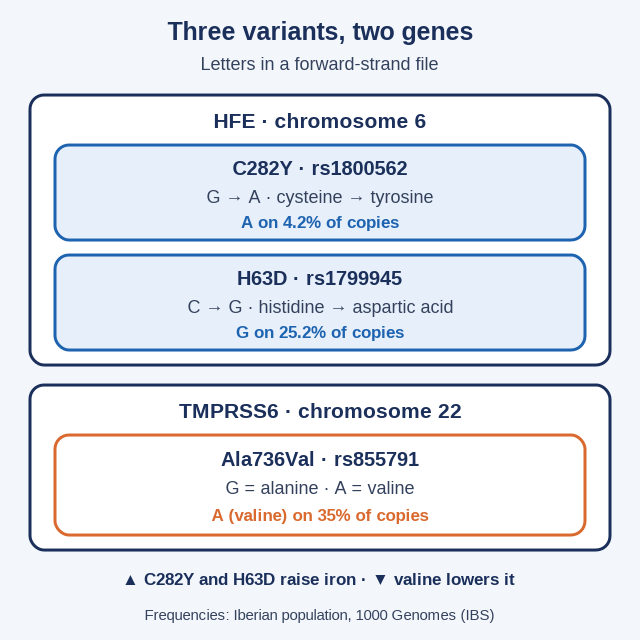
This post uses three variants. The first two are in the HFE gene, on chromosome 6:
- rs1800562, the C282Y variant: a G becomes an A and, at position 282 of the protein, a cysteine is replaced by a tyrosine. In the Iberian population of the 1000 Genomes Project (IBS), the A allele is on 4.2% of gene copies.
- rs1799945, the H63D variant: a C becomes a G and a histidine is replaced by aspartic acid at position 63. It is much more common: 25.2% of copies in the same Iberian sample.
The third is in TMPRSS6, on chromosome 22: rs855791, which swaps an alanine for a valine (Ala736Val; depending on the protein version a database uses, the position appears as 727). This gene is read from the reverse strand of the genome, so in a file using the forward strand the valine shows as A and the alanine as G. The valine is on 35% of copies in the Iberian sample.
The mechanism, step by step
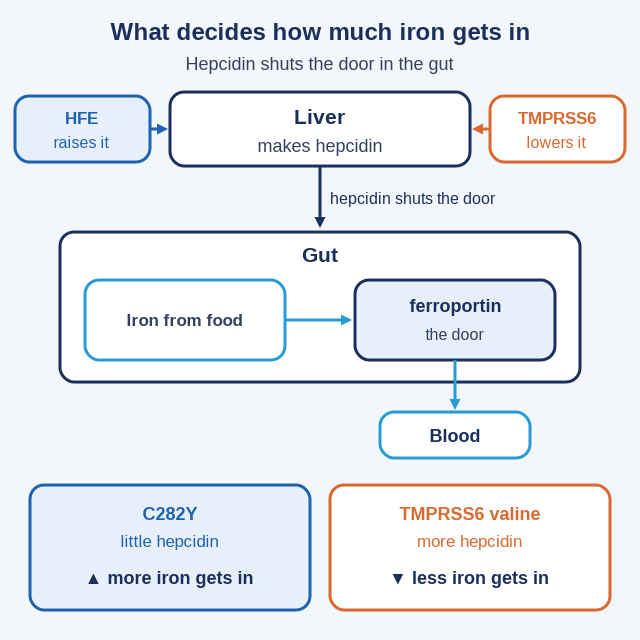
1. The body can barely get rid of iron, so it controls how much it absorbs. In the gut, iron enters the cells and passes into the blood through ferroportin, the only exit door (Crawford and colleagues, 2023).
2. Hepcidin shuts that door. The liver makes hepcidin when there is iron to spare, and hepcidin blocks ferroportin. In haemochromatosis, hepcidin is too low for the iron present, and that is why too much is absorbed (Crawford and colleagues, 2023).
3. HFE helps raise hepcidin; TMPRSS6 lowers it. With C282Y, HFE does not do its job and hepcidin stays low, so more iron comes in than is needed. TMPRSS6 makes matriptase-2, which holds back hepcidin production; the valine version has been linked to more hepcidin (Valenti and colleagues, 2012) and to lower blood iron and transferrin saturation (Benyamin and colleagues, 2009).
4. That is why the effects point in opposite directions. The HFE variants raise iron, ferritin and transferrin saturation, and so does the TMPRSS6 alanine, while the valine lowers them (Gill and colleagues, 2019).
Genotype and diet: what the evidence says
The base for everyone is to meet iron needs from food: EFSA sets a reference intake of 11 mg a day for men and for women after the menopause, and 16 mg for women before the menopause (EFSA, 2015). On top of that base, each genotype has its own guidance. The tables summarise results from groups of people and do not predict your case. Genotypes are named as in the papers and, in brackets, with the letters of a forward-strand file.
HFE (rs1800562 and rs1799945)
| Your genotype | What has been seen | What you can do |
|---|---|---|
| C282Y/C282Y (AA at rs1800562) | Among 203 Australians with this genotype, after 12 years of follow-up, 28.4% of the men and 1.2% of the women had documented iron-overload disease (Allen and colleagues, 2008). In UK Biobank, haemochromatosis was diagnosed in 21.7% of the men and 9.8% of the women, and the men had more liver disease (OR 4.30) and diabetes (OR 1.53) (Pilling and colleagues, 2019). It is rarer in Spain: one in 671 blood donors (Crawford and colleagues, 2023). | Ask your health professional to measure your transferrin saturation and ferritin: with this genotype, those two values are enough to diagnose haemochromatosis (EASL, 2022), and timely treatment prevents the damage. At the table, while your professional checks whether there is overload: do not take iron supplements or iron-fortified foods, such as some breakfast cereals, on your own initiative; vitamin C supplements no higher than the recommended intake; little alcohol; and no oysters or raw shellfish (Adams and colleagues, 2018; Crawford and colleagues, 2023). Red meat does not need to be restricted. If a blood test confirms you are short of iron, it is treated as your professional advises. If overload is confirmed, as something to try, drink black tea with your main meals: in a trial with 18 patients with haemochromatosis, tea cut iron build-up by a third over a year (Kaltwasser and colleagues, 1998). |
| C282Y/H63D (GA at rs1800562 and CG at rs1799945) | It usually has no clinical consequences, but it can harm the liver when combined with other factors such as regular drinking or fatty liver (Crawford and colleagues, 2023). In UK Biobank, haemochromatosis was diagnosed more often than with no variants, although the rise in other conditions was much smaller than with two copies of C282Y (Pilling and colleagues, 2019). | Your levers are alcohol and weight, because they are what turn this genotype into a problem: alcohol only occasionally, and a weight that does not build fat in the liver. Do not take iron supplements or multivitamins with iron on your own initiative: if a test shows you are short, your professional decides how to treat it. Ask for transferrin saturation and ferritin at your next blood test: if they show too much iron, as something to try, black tea with your main meals; if they show you are short, follow the treatment your professional prescribes. |
| H63D/H63D (GG at rs1799945) | The Asian Pacific guideline groups it with the previous genotype: if iron overload with damage appears, it recommends checking for rarer variants at a specialist centre (Crawford and colleagues, 2023). | Ask once for transferrin saturation and ferritin. No iron supplements on your own initiative (if a test shows you are short, your professional decides how to treat it), and keep alcohol occasional. If the values come back high, discuss with your professional whether a fuller assessment is needed. |
| One copy of C282Y (GA at rs1800562) | With one copy, transferrin saturation and ferritin tend to be somewhat higher than with no variants; HFE variants are used as genetic markers of higher iron (Gill and colleagues, 2019). | As something to try and observe: get your iron from food and do not take iron supplements "just in case" without a blood test, especially if you are a man or no longer have periods, because your genotype tilts you towards the high side. If you have periods, meet the reference intake from food like anyone else. |
| One copy of H63D (CG at rs1799945) | The same direction as one copy of C282Y: H63D is also used as a genetic marker of higher iron (Gill and colleagues, 2019). | As with one copy of C282Y, with less reason for caution: get your iron from food and avoid iron supplements unless a blood test supports them. |
| Neither variant (GG at rs1800562 and CC at rs1799945) | This is the reference: you do not have the upward push from HFE. | If you have periods, are pregnant or eat few foods of animal origin, make iron sources a daily habit (pulses, meat, fish, eggs, nuts) and pair plant iron with a food rich in vitamin C, which can increase its absorption according to the Asian Pacific guideline (Crawford and colleagues, 2023). If you are not in those groups, the reference intake from a varied diet is your goal. |
TMPRSS6 (rs855791)
| Your genotype | What has been seen | What you can do |
|---|---|---|
| Val/Val (AA in the file) | The valine is linked to lower blood iron and transferrin saturation (Benyamin and colleagues, 2009), and in an Italian series with fatty liver, Val/Val people had less iron in the liver and lower ferritin (Valenti and colleagues, 2012). In pregnant women, with lower iron and more iron-deficiency anaemia according to a review of seven studies (Fauzan and colleagues, 2025); a meta-analysis of 13 studies found no link with anaemia overall (Muruganantham and Veerabathiran, 2025). | As something to try and observe, if you have periods, are pregnant or planning to be, or eat few foods of animal origin: a source of iron at every main meal, plant iron paired with vitamin C (peppers, citrus, strawberries), and tea and coffee kept away from those meals, because tea reduces iron absorption (Kaltwasser and colleagues, 1998). Ask for ferritin to be included in your blood test. Supplements only if a test shows you are short and your professional prescribes them. |
| Ala/Val (AG or GA) | One copy of each version: if the effect adds up per copy, you sit between the two extremes. | As something to try, in the same groups: at least one source of iron a day and plant iron with vitamin C at meals without meat or fish. |
| Ala/Ala (GG) | This is the genotype that raises iron and ferritin; Gill and colleagues (2019) used it as one of the three iron-raising variants. | Get your iron from food and, if you are a man or no longer have periods, avoid iron supplements unless a blood test supports them. If you also carry C282Y or H63D, both genes push in the same direction: one more reason to ask for your ferritin. |
On the levels of evidence: the guidance for C282Y/C282Y comes from clinical guidelines and has the level ‘Established clinical application’; diet changes do not replace treatment by venesection, and a systematic review estimated that restricting absorbed iron might save between half a litre and a litre and a half of venesection a year, with no randomised trials (Moretti and colleagues, 2013). The link of H63D, of one copy of C282Y and of TMPRSS6 with blood iron has been replicated in large studies (‘Replicated association, uncertain clinical utility’). The diet guidance for TMPRSS6 and for carriers of one copy is a CESGEN suggestion that follows the mechanism, without trials by genotype, and is graded by the number of copies (‘Exploratory, not actionable’). What does it mean to have higher or lower iron because of your genes? In UK Biobank, Gill and colleagues (2019) used the three variants in this post together to estimate the effect of genetically determined iron: for each standard deviation more of blood iron, there was less iron-deficiency anaemia (OR 0.72) and less high cholesterol (OR 0.88), and more skin infections of the leg (OR 1.25). These are effects of the iron level, not the risk of carrying a particular variant. Diet also moves iron: in a European study, eating more haem iron (the iron in meat) was linked to higher ferritin, and so were the HFE and TMPRSS6 variants (Meidtner and colleagues, 2018).
If you have a genetic file
If your file is from 23andMe or AncestryDNA, look for rs1800562, rs1799945 and rs855791 (the steps are in the genetic file guide). This post uses the letters of the forward strand of the reference genome, as in dbSNP; check in your file's header or documentation which strand it uses. With TMPRSS6 it is easy to get confused, because the gene is read from the reverse strand: on the forward strand, valine is A and alanine is G.
| What you will see in your file | What this post calls it | What has been seen |
|---|---|---|
| rs1800562: AA | C282Y/C282Y | Risk of haemochromatosis; diagnosed with transferrin saturation and ferritin |
| rs1800562: GA or AG, and rs1799945: CG or GC | C282Y/H63D, if they are on different copies of the gene | Usually no consequences unless other factors add up |
| rs1800562: GA or AG, and rs1799945: CC | One copy of C282Y | Somewhat higher iron |
| rs1800562: GG, and rs1799945: GG | H63D/H63D | Higher iron; checked if there is overload |
| rs1800562: GG, and rs1799945: CG or GC | One copy of H63D | Somewhat higher iron |
| rs1800562: GG, and rs1799945: CC | Neither variant | The reference |
| rs855791: AA / AG or GA / GG | Val/Val / Ala/Val / Ala/Ala | Lower / intermediate / higher iron |
| Any other combination (for example, a T at rs1799945, a single letter, dashes or zeros) | Cannot be determined from this file |
Two warnings. With one copy of C282Y and one of H63D, a file does not tell you whether they sit on the same copy of the gene or on different ones; the C282Y/H63D combination in the studies is the one on different copies, which is the usual case, but only a clinical genetic test confirms it. And rs1799945 can carry a T instead of the G, a rare variant that is not H63D. This table describes what has been seen in studies and does not replace an assessment by a health professional.
What to bear in mind when applying it
The genotype points the way and the blood test confirms. In haemochromatosis, the diagnosis rests on transferrin saturation and ferritin, not on the genotype alone (EASL, 2022). High ferritin has many other causes, such as inflammation, alcohol or fatty liver.
The effect depends on sex and age. Women lose iron through periods and pregnancy, so with C282Y/C282Y they develop less disease, and later (Allen and colleagues, 2008; Pilling and colleagues, 2019).
The studies are in people of European ancestry. C282Y is rare in people of African and Asian ancestry (Crawford and colleagues, 2023), and the results of Gill and colleagues (2019) come only from Europeans.
This post does not recommend supplements because of a variant. Taking iron, or cutting it from your diet, because of a genetic result without a blood test is not supported; your professional decides with your test results.
What you can do with this information
If you carry C282Y/C282Y, ask for transferrin saturation and ferritin. It is the combination with the strongest evidence in this post, and catching it early prevents the damage. While overload is being assessed, no iron supplements or fortified foods on your own initiative, vitamin C supplements no higher than the recommended intake, little alcohol and no raw shellfish; if you are short of iron, your professional treats it.
If you carry other HFE variants or Ala/Ala in TMPRSS6, get your iron from food and do not supplement it on your own. With C282Y/H63D, look after alcohol and weight above all.
If you carry Val/Val in TMPRSS6 and have periods, are pregnant or eat little meat and fish, look after absorption. A source of iron at every main meal, vitamin C with plant iron, and tea and coffee away from those meals.
Ask for your result to be read in the light of your situation. If you know your genotype, discuss it with your health professional together with your blood test, age and diet: that way it becomes a useful clue rather than a label.
Sources
- EASL Clinical Practice Guidelines on haemochromatosis, European Association for the Study of the Liver. Journal of Hepatology 77:479-502 (PMID 35662478), 2022
- Clinical practice guidelines on hemochromatosis: Asian Pacific Association for the Study of the Liver, Crawford DHG et al. Hepatology International 17:522-541 (PMID 37067673), 2023
- Therapeutic recommendations in HFE hemochromatosis for p.Cys282Tyr (C282Y/C282Y) homozygous genotype, Adams P et al. Hepatology International 12:83-86 (PMID 29589198), 2018
- Iron-overload-related disease in HFE hereditary hemochromatosis, Allen KJ et al. New England Journal of Medicine 358:221-230 (PMID 18199861), 2008
- Common conditions associated with hereditary haemochromatosis genetic variants: cohort study in UK Biobank, Pilling LC et al. BMJ 364:k5222 (PMID 30651232), 2019
- Associations of genetically determined iron status across the phenome: a mendelian randomization study, Gill D et al. PLoS Medicine 16:e1002833 (PMID 31220083), 2019
- Common variants in TMPRSS6 are associated with iron status and erythrocyte volume, Benyamin B et al. Nature Genetics 41:1173-1175 (PMID 19820699), 2009
- Novel loci affecting iron homeostasis and their effects in individuals at risk for hemochromatosis, Benyamin B et al. Nature Communications 5:4926 (PMID 25352340), 2014
- The A736V TMPRSS6 polymorphism influences hepatic iron overload in nonalcoholic fatty liver disease, Valenti L et al. PLoS One 7:e48804 (PMID 23144979), 2012
- Impact of TMPRSS6 genetic variants on maternal iron status in pregnancy: a systematic review, Fauzan R et al. Birth Defects Research 117:e2538 (PMID 41097872), 2025
- Lack of association between the TMPRSS6 gene polymorphism (rs855791) and anemia: a comprehensive meta-analysis, Muruganantham JK, Veerabathiran R. Hematology, Transfusion and Cell Therapy 47:103737 (PMID 40081160), 2025
- Relevance of dietary iron intake and bioavailability in the management of HFE hemochromatosis: a systematic review, Moretti D et al. American Journal of Clinical Nutrition 98:468-479 (PMID 23803887), 2013
- Clinical trial on the effect of regular tea drinking on iron accumulation in genetic haemochromatosis, Kaltwasser JP et al. Gut 43:699-704 (PMID 9824354), 1998
- Interaction of dietary and genetic factors influencing body iron status and risk of type 2 diabetes within the EPIC-InterAct study, Meidtner K et al. Diabetes Care 41:277-285 (PMID 29167213), 2018
- Scientific Opinion on Dietary Reference Values for iron, EFSA Panel on Dietetic Products, Nutrition and Allergies (NDA). EFSA Journal 13(10):4254, 2015
- Ensembl and dbSNP, rs1800562, rs1799945 and rs855791: alleles, forward strand, consequence and 1000 Genomes Project frequencies (GRCh38), NCBI dbSNP and Ensembl, consulted on 24/11/2026, 2026
Educational content from CESGEN, based on the evidence published up to the review date. It does not replace individual medical or dietary advice: to apply it to your own case, talk it through with your health professional. Nutrigenetics is an evolving field, and we review each piece when the evidence changes.